
Advertorial · Updated August 21, 2026 · 8 minute read
DOG HEALTH • EVERYDAY FUNCTION
Your Dog’s Weight Isn’t About Looks. It’s About What His Body Has to Do All Day.
A rounder body can be cute. The more important question is what that body has to carry through every walk, stair, jump and ordinary day.
Author’s note: In practice, I find that weight conversations become much more useful when we stop talking about appearance and start talking about function. In this article, I want to show you why I assess body condition through the everyday movement and quality of life it can influence.

By Dr. Daniel Whitmore, DVM
Veterinarian focused on senior canine health and healthy aging · August 21, 2026 · 8 min read
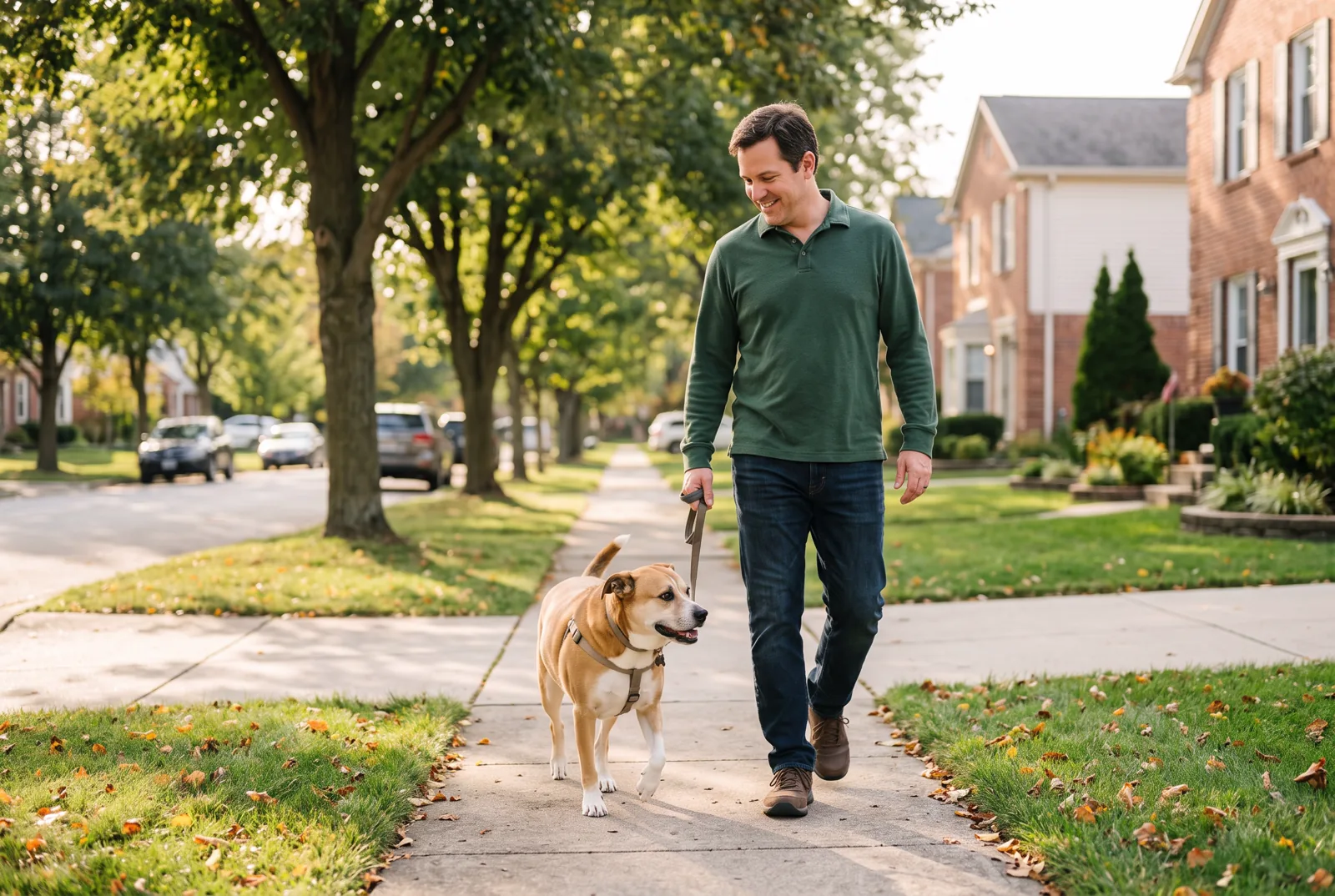
If you have ever looked at your dog and thought, “Yes, he is a little chunky, but I love him exactly as he is,” that reaction makes perfect sense.
Weight conversations often sound cosmetic.
Slimmer waist.
Better shape.
Less belly.
But appearance is the least interesting reason to care about body condition.
The real issue begins when you stop looking at the dog standing still and start looking at what that body does all day.
Because your dog does not wear his body for a photo.
He moves it.
This is also where owner perception can mislead us. In the Association for Pet Obesity Prevention’s 2022 U.S. prevalence survey, 59% of dogs were classified as overweight or having obesity. Yet in a subsequent owner survey, only 17% of dog owners described their own dog as overweight.
That gap is exactly why I do not start this conversation with appearance. Familiar bodies stop looking unusual. Function is harder to dismiss.
“Chunky but Cute” Can Still Be the Wrong Conversation
A dog can look adorable at almost any size.
That is why appearance is such a weak motivator.
Owners do not want their dog to look like a fitness model.
They want him to keep doing the things that make him feel like himself.
Following them from room to room.
Climbing into the car.
Walking the familiar route.
Getting up when the leash comes out.
Joining the family instead of watching from the bed.
When you frame healthy weight around those moments, the conversation changes immediately.
The goal is not a prettier silhouette.
The goal is to make sure body condition is not quietly becoming one more thing the dog has to work around.
Extra Weight Moves With Him Everywhere
Think about a normal day from your dog’s perspective.
Stand up from the floor.
Walk to the kitchen.
Turn around when someone calls.
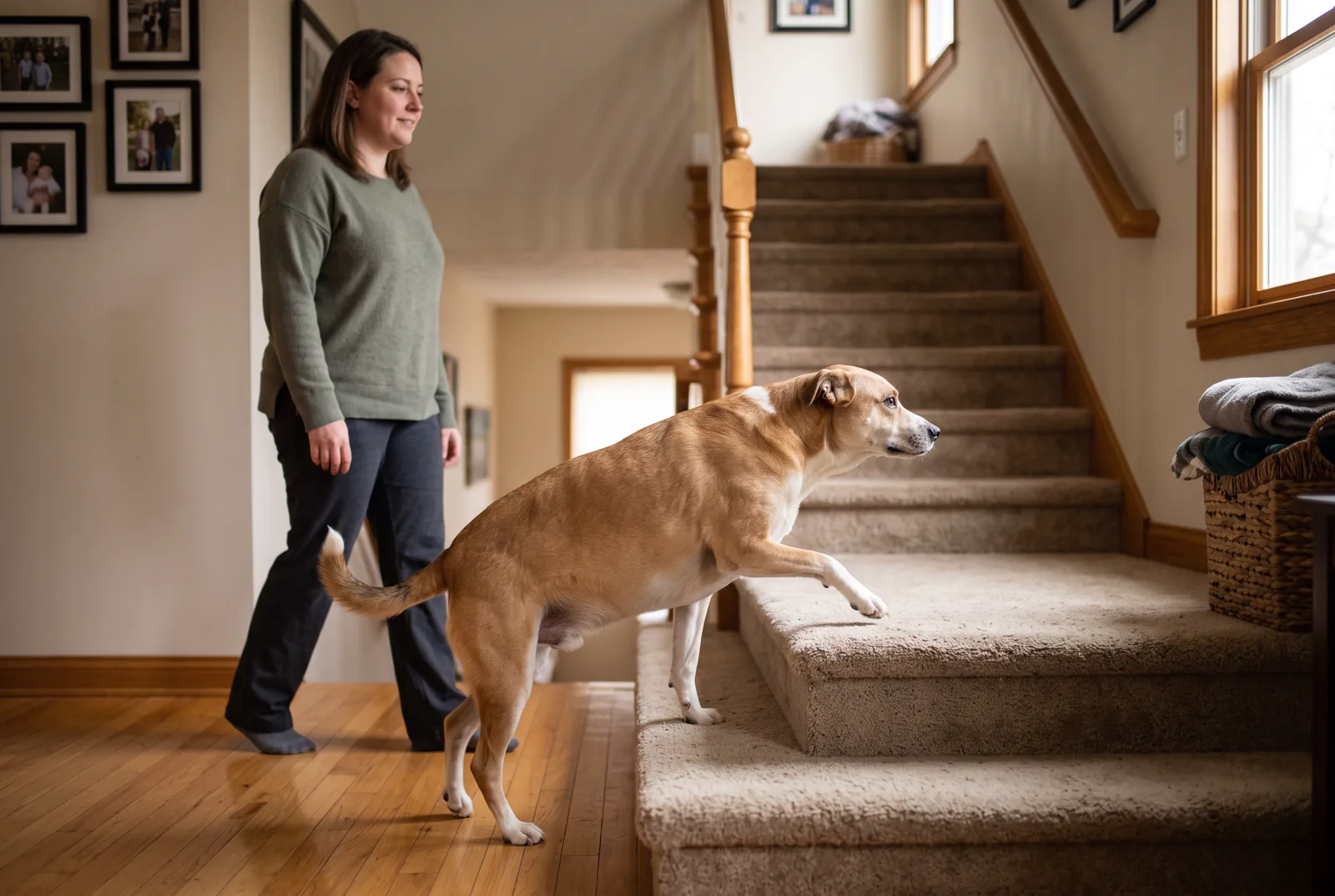
Climb two steps.
Jump into the car.
Walk around the block.
Get back up after a nap.
Every one of those movements means moving the whole body.
That is what makes extra weight different from something cosmetic.
It does not sit separately from daily life.
It becomes part of every movement inside it.
Gradual Change Becomes Familiar Before It Feels Important
Most dogs do not gain body fat in one obvious jump.
The waist becomes a little less visible.
The ribs become a little harder to feel.
The body gets rounder by degrees.
And because the owner sees the dog every day, each tiny change is absorbed into a new definition of normal.
That is why “he has always been built like that” can feel true even when the body has changed slowly over time.
A simple body-condition check can interrupt that familiarity.
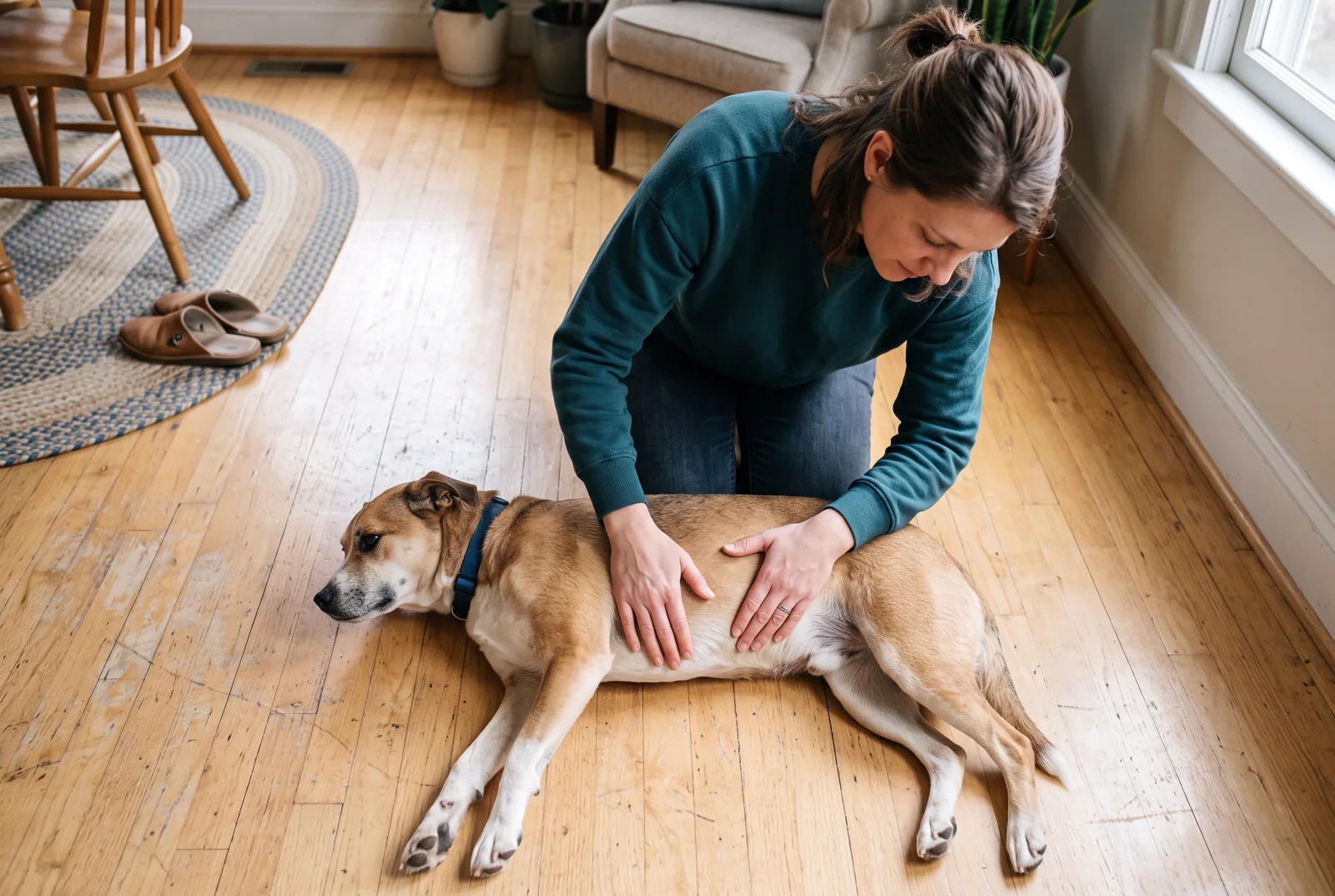
Look from above. Is there a visible waist behind the ribs?
Feel the ribs. Can you feel them easily without pressing hard?
Look from the side. Is there an upward tuck behind the rib cage?
The purpose is not to label the dog.
It is to look at body condition more deliberately than familiarity allows.
The Stakes Are Function, Healthspan and Time Together
A smaller number on the scale is not emotionally meaningful by itself. More usable everyday life is.
There is also a reason veterinarians take long term body condition seriously. In the well known lifetime study of 48 Labrador Retrievers, dogs fed 25% less than their paired littermates stayed leaner and had a median lifespan 1.8 years longer, with later onset of chronic disease, especially osteoarthritis.
That study was not a study of any weight-management product, and it does not mean reducing any individual dog’s food by 25% is appropriate. What it does show is that body condition is not a beauty metric. It belongs in the healthspan conversation.
That is why I care about the dog who still wants the full walk, joins the family upstairs and gets into the car because something good is about to happen. The silhouette is secondary. Participation is the point.
The Problem Aware Owner Has Usually Tried More Than “Feed Less”
Owners who already know their dog is heavy usually arrive with a history.
They bought the light kibble. They cut treats for a while. They tried a longer walk. They measured carefully for three days. Then the dog stood beside the bowl, stared, followed them into the kitchen and made the smaller dinner feel like deprivation.
That is the emotional friction most weight advice ignores.
The problem is not a lack of information. It is the guilt loop: smaller bowl, hungry looking dog, guilty owner, extra bite, uncertain portions, no reliable deficit.
A successful routine has to break that loop at the bowl, not merely explain calories one more time.
Make the Meal Look Like a Meal Again
There is a useful analogy from human nutrition: a bowl of broth based soup can occupy far more physical space than a small, calorie dense snack. Water and volume change the eating experience without erasing calorie math.
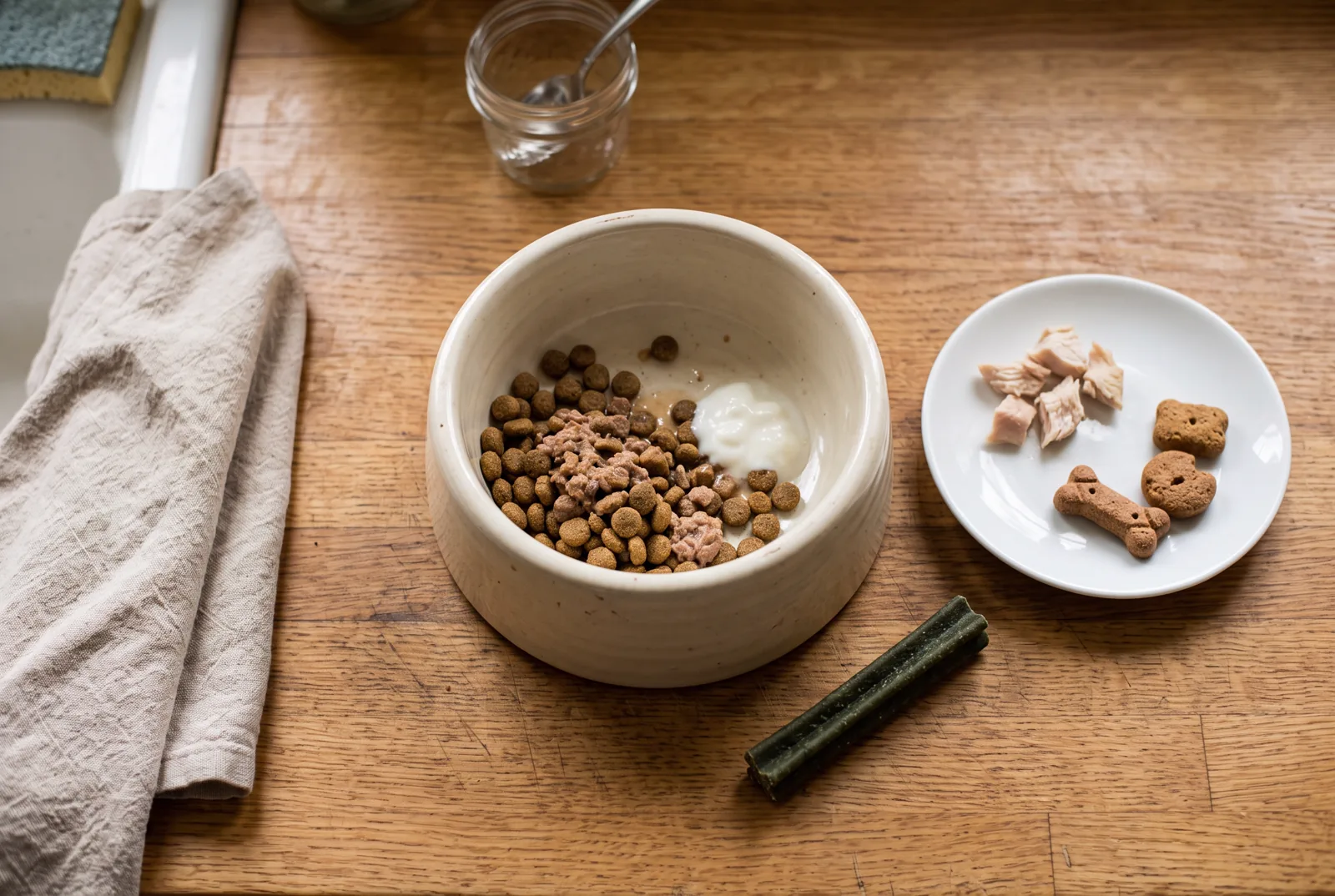
That is the principle I want here. Reduce the calorie dense base food deliberately, then use water, fiber and physical meal volume to make the new bowl feel like a complete feeding ritual rather than a punishment.
The goal is not to trick the dog or pretend calories do not matter. It is to build a meal format that makes the required calorie control easier for a real household to repeat.
The Approach I Looked At: BOWLFUL by Holypup
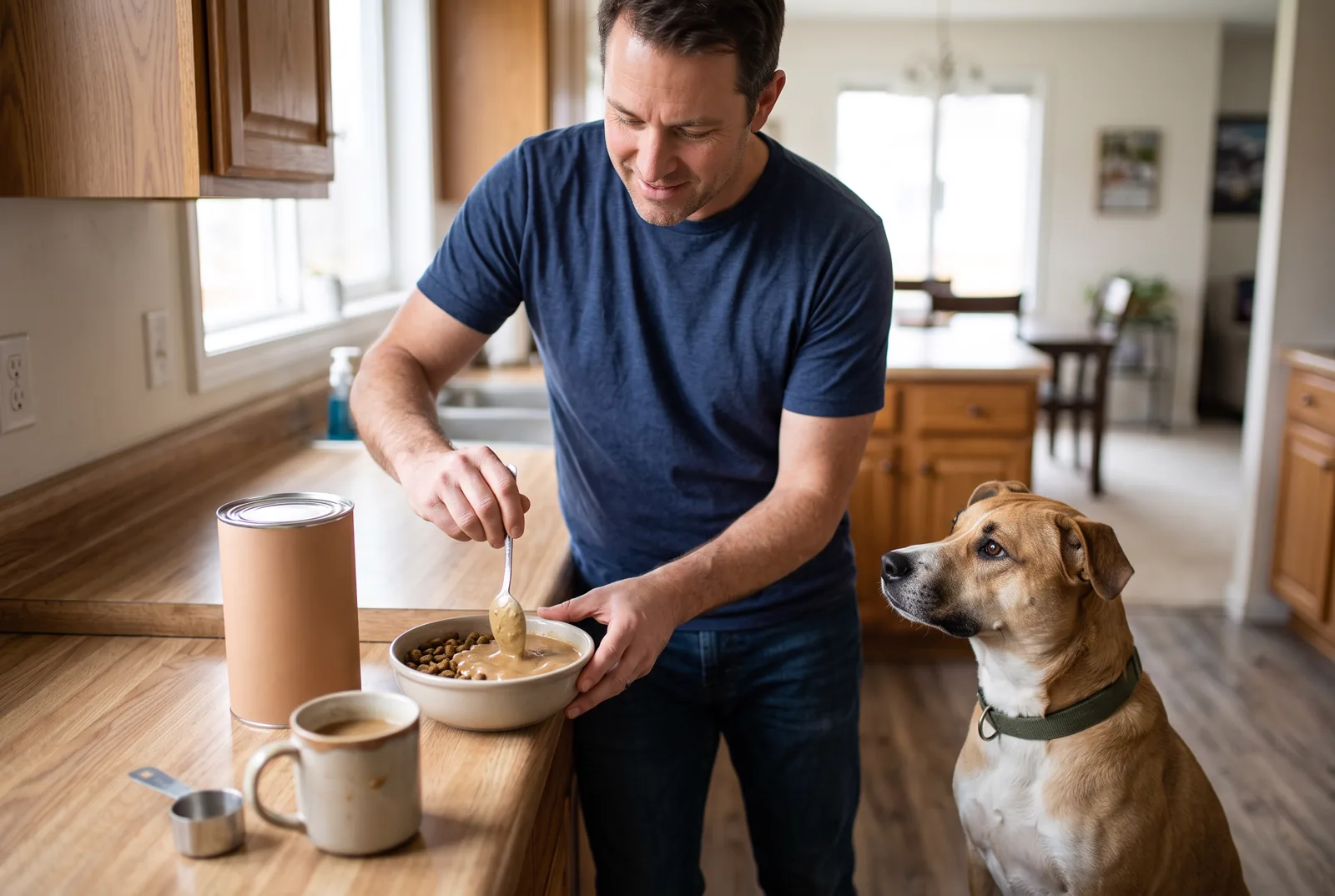
BOWLFUL by Holypup is a fiber-rich powder that is mixed with warm water into a gravy before it ever reaches the bowl.
The measured serving is combined with warm water, allowed to thicken for one to two minutes, then mixed into a measured portion of the dog’s regular food.
The formula provides 49% total dietary fiber, with gum arabic, pea fiber, psyllium seed husk and dried beet pulp among its fiber sources. The prepared gravy also brings a meaningful amount of water and physical volume into the meal.
That creates a more useful weight-management routine than simply staring at a smaller pile of food.
BOWLFUL is introduced gradually. Once the dog is accustomed to the full serving, the regular food portion is reduced in stages, up to 15% in the standard feeding plan.
49% fiber: nearly half of the powder by weight is dietary fiber, prepared with water so the smaller calorie base can still become a substantial-looking meal.
Up to 15% less base food: the practical benefit is not a prettier number on the bag; it is a defined reduction in the calorie-dense food the dog carries into every ordinary activity.
Timeline: Week 1 introduces the new meal format → Week 2 establishes the full serving → Week 4 has the reduced-base-food routine underway → Week 8 is about making the function-first routine automatic.
BOWLFUL does not make a dog lose weight. The reduced base food portion changes the calorie input. BOWLFUL is designed to make that smaller portion into a fuller, more structured meal that is easier for the household to keep serving.
That distinction is why the product fits this angle. If the goal is not to make a dog look thinner, but to manage one controllable part of his everyday physical load, the useful product is the one that helps turn calorie control into a repeatable daily behavior.
For an owner who cares about everyday function rather than appearance, that is the relevant product connection: not a cosmetic promise, but a practical way to act on body condition meal after meal.
Your Dog Does Not Need to Look Different for This to Matter
If you love the way your dog looks, keep loving the way your dog looks.
That is not the point.
The more useful question is whether his current body condition is helping or adding unnecessary load to the everyday life you want him to keep enjoying.
That is a question about function.
And unlike age, it is a factor that can often be acted on with a clearer feeding plan.
Next Step
The next page explains how BOWLFUL by Holypup works, how the phased feeding routine is structured and what the current purchasing options are.
The commercial offer lives on the dedicated Offer Page, not inside this advertorial.
Evidence Sources
- Association for Pet Obesity Prevention, 2022 U.S. prevalence and owner perception findings: APOP survey summary
- Lawler DF et al., review of the lifetime Labrador diet restriction study reporting 1.8 years longer median lifespan among diet-restricted dogs: PubMed
These sources support the editorial discussion of body condition, owner perception and long-term health. They are not studies of BOWLFUL.