
Advertorial · Updated August 21, 2026 · 9 minute read
CANINE HEALTH • MOBILITY
Your Dog’s Joint Supplement Can’t Change This Second Lever
If you already give your dog glucosamine, fish oil, green-lipped mussel or another mobility supplement, you are not doing nothing. You have already decided his movement matters. The question is whether you are only working on one side of the problem.
Author’s note: I often meet owners who are already doing something thoughtful for their dog’s joints. My goal here is not to replace that routine. I want to explain the second lever I assess as a veterinarian: the amount of body weight those joints have to move every day.

By Dr. Daniel Whitmore, DVM
Veterinarian focused on senior canine health and healthy aging · August 21, 2026 · 9 min read

Owners who buy joint supplements are often some of the most attentive dog owners there are.
They notice the pause before the stairs.
They notice the slower start after a nap.
They notice when the walk is not quite the same.
Then they act.
They buy a chew.
They add oil.
They look for ingredients associated with joint support.
That instinct makes sense.
But there is one thing no joint supplement can change:
The amount of body those joints have to carry.
That is a different lever.
And for many dogs, it is the lever owners never realize is there.
Joint Support and Mechanical Load Are Two Different Jobs
A joint supplement is designed around the joint itself.
Depending on the product, that may mean ingredients intended to support normal joint structure, comfort or function.
That is one job.
But there is another job happening every time the dog moves.
The joint has to carry and move the body above it.
A supplement can be part of a mobility routine without changing that load at all.
That distinction is not an argument against supplements. A randomized controlled trial in 38 dogs with osteoarthritis, for example, found improved weight bearing in many dogs fed a diet containing fish oil omega 3 fatty acids over 90 days. Joint focused interventions can have a legitimate place.
But compare the job being done. In a separate 16 week study of 14 obese dogs with osteoarthritis, weight loss alone was associated with significant reductions in lameness, with improvement appearing from about 6.1% to 8.85% body weight reduction, depending on the measure used.
Two different interventions. Two different levers.
That is the point I want owners to keep: your current joint routine may be useful, but it cannot reduce the body weight those joints carry.
Is Your Dog Carrying More Than You Think?
This is where many owners get surprised.
Body condition can change slowly enough that the new shape becomes familiar before it feels different.
A little less waist.
Ribs that become a little harder to feel.
A body that looks slightly rounder from above.
Then “slightly rounder” becomes simply “how he looks.”
That is why the most useful first step is not guessing.
It is checking.
Look from above. Can you still see a waist behind the ribs?
Feel the ribs. Can you feel them easily without pressing hard?
Look from the side. Is there an upward tuck behind the rib cage?
If all three look appropriate, useful. If one or more make you pause, body condition deserves a closer look.

Every Step Is Also a Load Event
Now the distinction becomes easier to see.
When your dog stands up, the joints move the body.
When he climbs a stair, the joints move the body.
When he walks, turns, jumps or gets into the car, the joints move the body.
If that body is carrying more than an appropriate condition for its frame, the additional load travels through those same movements again and again.
That does not make the existing supplement wrong.
It makes the picture incomplete.
One lever focuses on the structure.
The second lever focuses on what the structure has to carry.
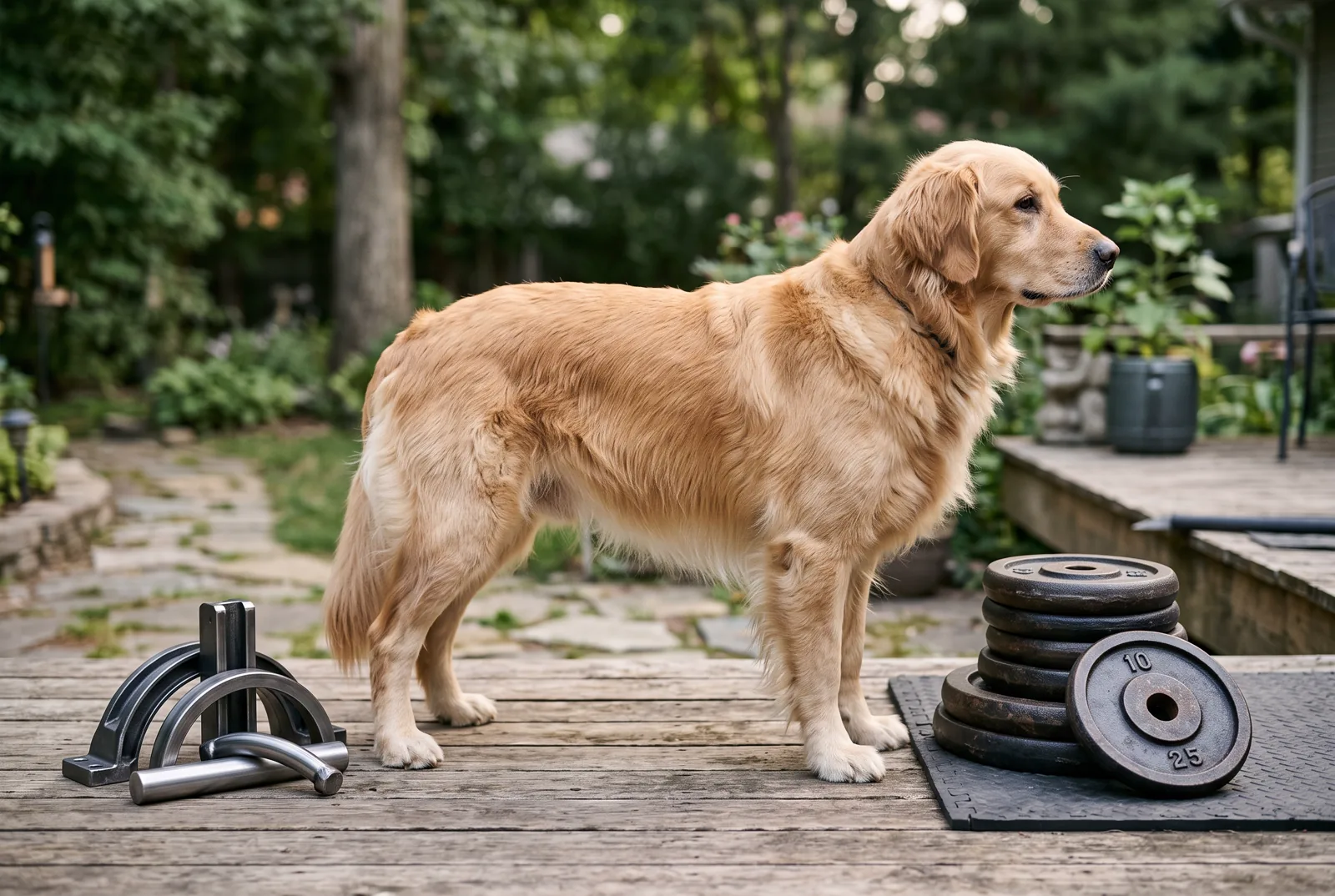
The Supplement Jar Is Visible. The Second Lever Is Easy to Miss.
A supplement arrives in a jar. It has a scoop, a chew or a dose. You can point to the thing you are doing.
Body condition has no jar. It changes slowly enough to disappear into familiarity.
That creates a common blind spot I see in attentive owners: they are disciplined with glucosamine, fish oil or another mobility routine, but the food scoop, treats and evening extras have never been treated as part of the same movement conversation.
The first lever feels active. The second feels like background.
My goal is not to replace the first. It is to make the second impossible to ignore.
You Are Not Replacing the Routine. You Are Completing the Picture.
If you already have a joint routine you trust, the point is not to throw it away.
The point is to ask whether there is another practical lever available.
Owners care about the same things either way.
The walk.
The stairs.
The car.
The toy.
The dog getting up because something interesting is happening.
If body condition is one factor making those movements more demanding, then addressing it can sit beside the joint routine rather than compete with it.
That is a much easier idea to act on than searching endlessly for “one better supplement.”

A Correct Principle Still Needs a Repeatable System
Once owners accept the second lever, they usually try the obvious move: scoop out less food.
Then dinner becomes emotionally harder than the supplement routine ever was. The chew is easy to give. The smaller bowl is harder to serve.
The dog stares. He follows someone back into the kitchen. A family member adds a little more. The evening treat comes back because everyone feels as if he has been deprived.
That is why “just feed less” is not the second lever. It is only the calorie instruction.
The second lever needs a repeatable meal format that can survive the owner’s guilt, the dog’s expectations and a household with more than one feeder.
Give the Second Lever Its Own Delivery System
A joint supplement has a delivery system: one chew, one scoop, one dose.
Weight management needs the same behavioral clarity.
A useful analogy is broth based soup. Water creates physical volume without turning the meal into the same amount of calorie dense dry food. Applied to the bowl, the idea is straightforward: deliberately reduce the regular food, then build volume around that smaller base with water and fiber.
The calorie reduction still comes from the smaller base portion. The added volume gives the second lever a meal ritual that feels complete enough to repeat.
That is what makes it fundamentally different from adding another supplement to the shelf.
BOWLFUL by Holypup: Not Another Joint Supplement
BOWLFUL by Holypup is not another joint supplement and is not presented as a joint treatment. The joint routine an owner already trusts can remain exactly where it is.
BOWLFUL works on a different part of the daily routine. It starts as a fiber-rich powder that is mixed with warm water into a gravy, allowed to thicken for one to two minutes, then combined with a measured portion of the dog’s regular food.
The formula provides 49% total dietary fiber, with gum arabic, pea fiber, psyllium seed husk and dried beet pulp among the fiber sources. Preparing the powder with water adds volume to the bowl as well.
The standard feeding plan introduces BOWLFUL gradually before reducing the regular food portion in stages, up to 15%.
49% fiber: nearly half of the powder by weight is dietary fiber, prepared with water to create a visibly fuller meal format around the measured base food.
Up to 15% less base food: the second lever is a defined daily reduction in the regular calorie-dense portion, not another capsule or chew added on top.
Timeline: Week 1 introduces BOWLFUL → Week 2 establishes the full serving ritual → Week 4 has the reduced-base-food routine underway → Week 8 is about making that second lever automatic.
The distinction matters:
BOWLFUL does not replace your joint supplement, and it does not make a dog lose weight by itself. The smaller base food portion is the calorie lever. BOWLFUL is designed to make that smaller portion into a fuller, more structured meal that can be repeated consistently.
That is the exact reason I see it as a second lever. Keep the mobility support you trust. Use a separate feeding system to address the body weight that support cannot change.
That makes it complementary to the owner’s existing mobility routine. One tool addresses joint support. The other helps the owner act on body condition and the load side of the picture.
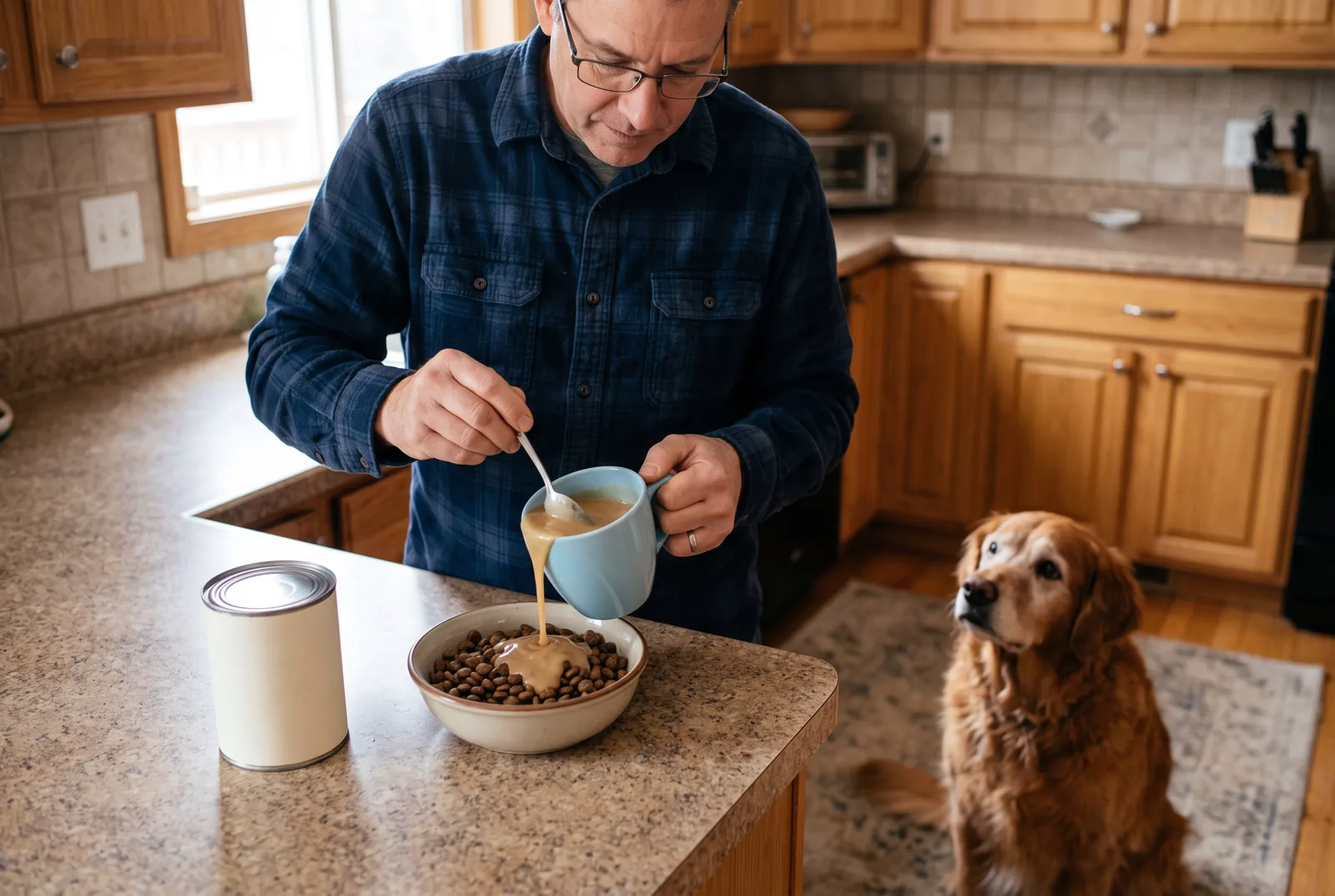
Keep the Support. Check the Load.
If your dog’s body condition is already appropriate, that is useful to know.
If it is not, then the routine may have been missing a second lever.
You do not need to choose between supporting the joint and managing body condition.
They are different jobs.
And once that distinction is clear, the next step becomes much simpler.
Next Step
The next page explains how BOWLFUL by Holypup is designed to fit into this structured feeding routine, including the phased plan, current purchasing options and available plans.
The commercial offer lives on the dedicated Offer Page, not inside this advertorial.
Evidence Sources
- Roush JK et al., Evaluation of the effects of dietary supplementation with fish oil omega-3 fatty acids on weight bearing in dogs with osteoarthritis, Journal of the American Veterinary Medical Association, 2010: PubMed
- Marshall WG et al., The effect of weight loss on lameness in obese dogs with osteoarthritis, Veterinary Research Communications, 2010: PubMed
These studies illustrate that joint-focused support and body-weight reduction are different interventions. They are not studies of BOWLFUL and do not imply that BOWLFUL treats osteoarthritis or lameness.