
Advertorial · Updated August 21, 2026 · 10 minute read
DOG HEALTH • JOINTS
Your Dog’s Joint Chew Can’t Do This One Thing
You give it every morning. You’re not sure it helps. A vet on the other half of joint care, the half that comes in a food bowl.
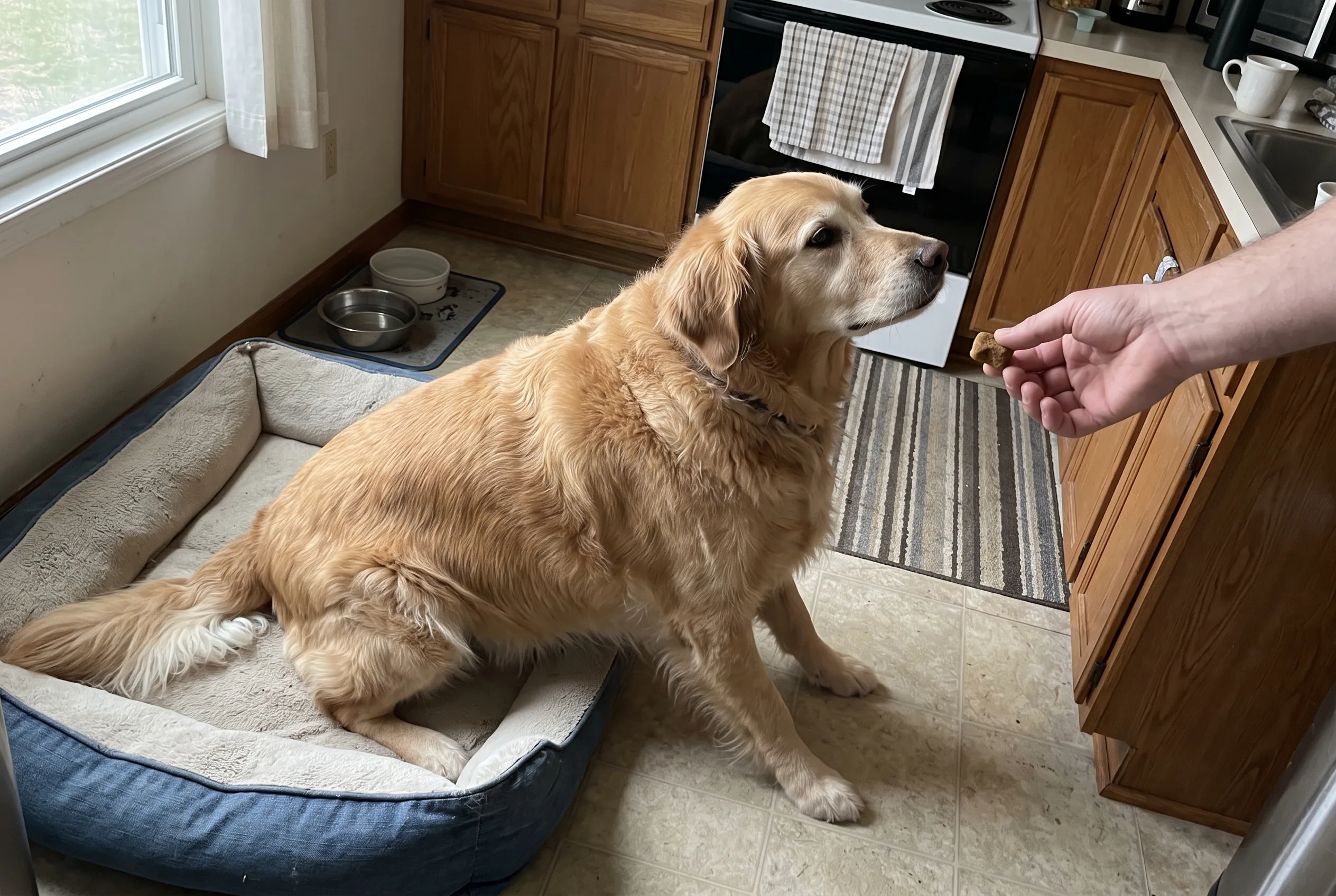
Author’s note: Owners who buy joint chews are the attentive ones. This is not about replacing what you do. It is about the part nobody told you was missing.

By Dr. Daniel Whitmore, DVM
Veterinarian focused on senior canine health and healthy aging · August 21, 2026 · 10 min read
You give him the joint chew every morning. Maybe fish oil at night. There are ramps by the couch now, and a thick bed in the corner.
Has it helped?
If you’re honest, the answer is usually the one I hear most: “Beats me. But it can’t hurt.”
You’re right. It probably can’t hurt. And you’re doing more than most.
Every pound he carries goes up the stairs with him, twice a day, for the rest of his life.
But here’s the thing I want you to sit with for a minute. Every morning, you’re working on one half of the problem. The half in the jar.
The other half is standing right there, wagging its tail, a little rounder than it used to be.
The Chew Is for the Joint. Something Else Is for What the Joint Carries.
Think about what a joint actually does when your dog gets up off the floor.
It bends. It takes the weight of everything above it. It pushes that weight up and forward. Then it does it again on the stairs, again at the car, again on the walk.
A joint chew is built around the first part. Depending on the product, it’s meant to support the joint itself. The cartilage, the cushion, the comfort.
That’s one job.
But nothing in a jar changes the second part. How much body the joint has to lift, every single time.
Two jobs. You’ve been doing one of them.
If your dog is carrying a few extra pounds, those pounds go through the same hips and elbows you’ve been supplementing. Every step. Every stair. Every hop onto the couch that now takes a run-up.
Two jobs. You’ve been doing one of them.
Your Routine Has Science Behind It. So Does the Other Half.
I want to be fair to what you’re already doing, because it’s not nothing.
In one controlled trial, 38 dogs with arthritis were fed a diet with added fish oil for 90 days. Many of them put more weight on their sore legs by the end. That’s real. If you give fish oil, you have a reason.
Now the other half.
In a separate study, 14 heavy dogs with arthritis were put on nothing but a diet. No new supplement, no new medicine. As they lost weight, they limped less. The improvement started showing up at about 6 percent of body weight lost. On a 70 pound dog, that’s a little over four pounds.
Four pounds. Not a transformation. A few pounds off, and the dogs moved measurably better.
Those were small studies. They were not studies of any product, and nothing I’m about to describe is a treatment for arthritis. But they tell you something useful: the half of joint care that’s in the food bowl has evidence behind it too. Some vets would say stronger evidence.
As one vet tech put it in a forum I follow:
“Our senior patients that are overweight don’t do as well as those that are a leaner weight.”
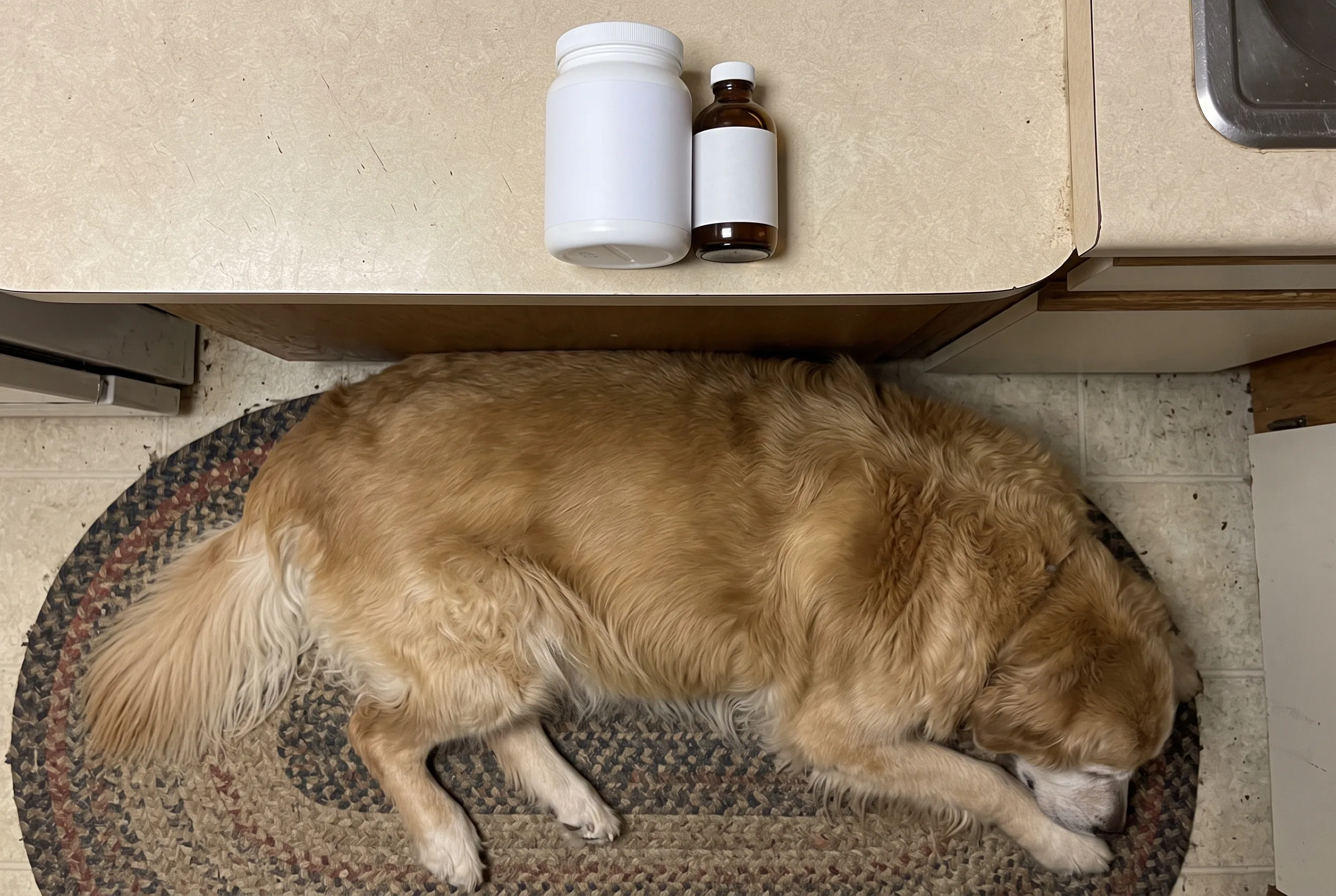
The Jar Is on the Counter. The Pounds Are in the Background.
Here’s why careful owners miss this, and it’s not carelessness.
A supplement comes in a jar. It has a scoop, or a chew, or a dropper. You can see yourself doing it. It’s on autoship. It feels like action, because it is action.
The extra pounds don’t come in a jar. They arrive a few ounces at a time over two or three years. The waist softens. The ribs get harder to feel. The body gets a little rounder, and then that’s just how he looks.
You see him every day. So you never see it happen.
You see him every day. So you never see it happen.
“So many people see overweight dogs that it becomes the normal,” a Shepherd owner wrote. She’s right. Most of the Goldens and Labs you pass on the sidewalk are carrying extra. A lean one looks thin to us now.
That’s how an owner can be perfect with the glucosamine for three years and never once think about the scoop of kibble.
Before We Talk About the Bowl, Check the Premise.
Maybe your dog is already lean. Then this article is a reassurance, and you can keep doing what you’re doing.
So check. Tonight.
Look from above. Stand over him while he’s standing. Is there a waist behind the ribs, or does he run straight from shoulders to hips?
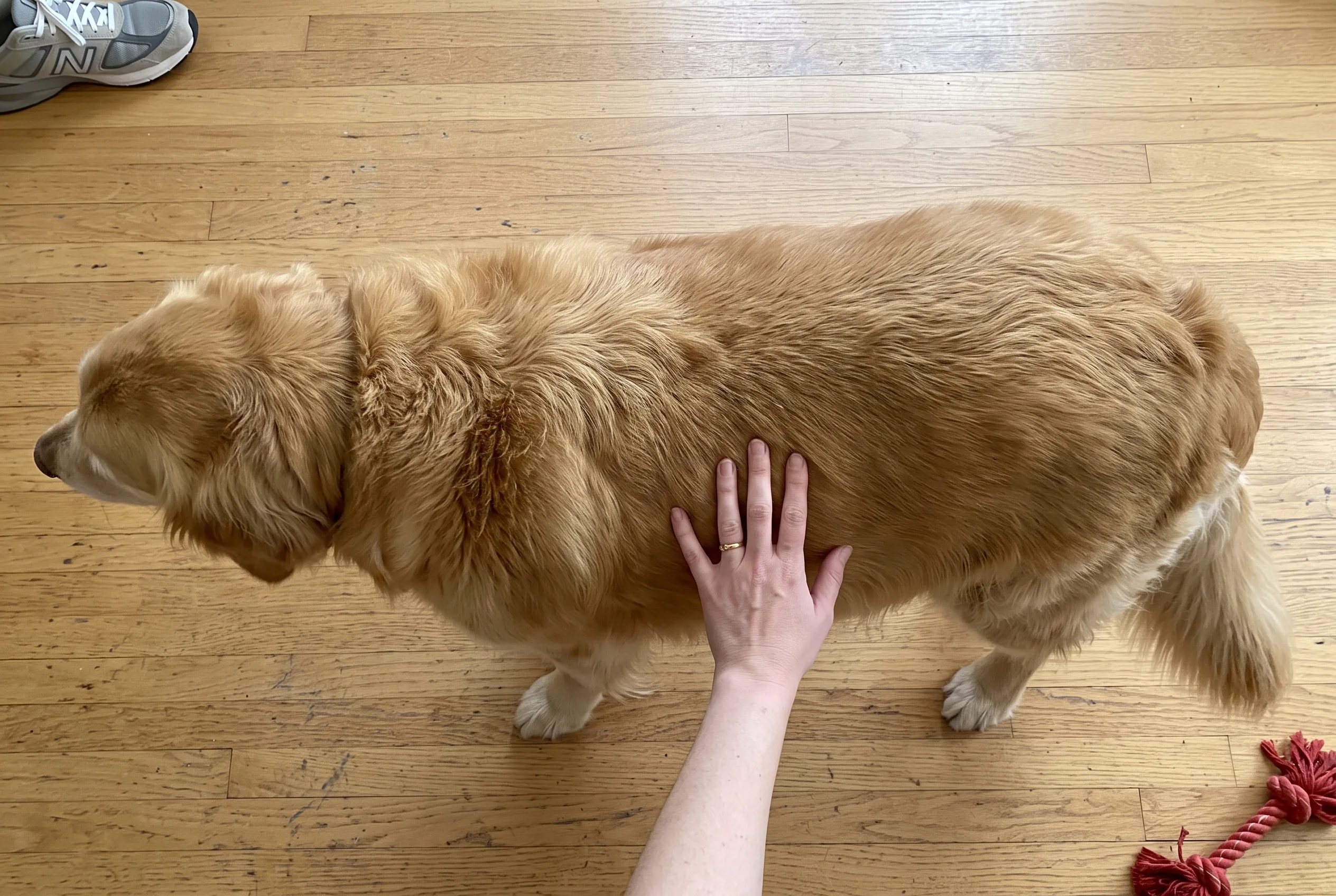
Feel the ribs. Flat fingers, light pressure, along his side. Can you find them easily, or do you have to press through?
Look from the side. Does the belly tuck up behind the rib cage, or hang level with it?
Three passes, good. Keep the chew, keep the walks, you’re done here.
One or two made you pause? Keep reading. The second job is waiting.
You’re Not Replacing the Routine. You’re Finishing It.
I know what this can feel like. You’ve been doing the right thing, carefully, for years, and now someone tells you there’s another thing.
So let me say it plainly. Keep the chew. Keep the fish oil. Keep the ramps.
None of it is wrong. It’s just half.
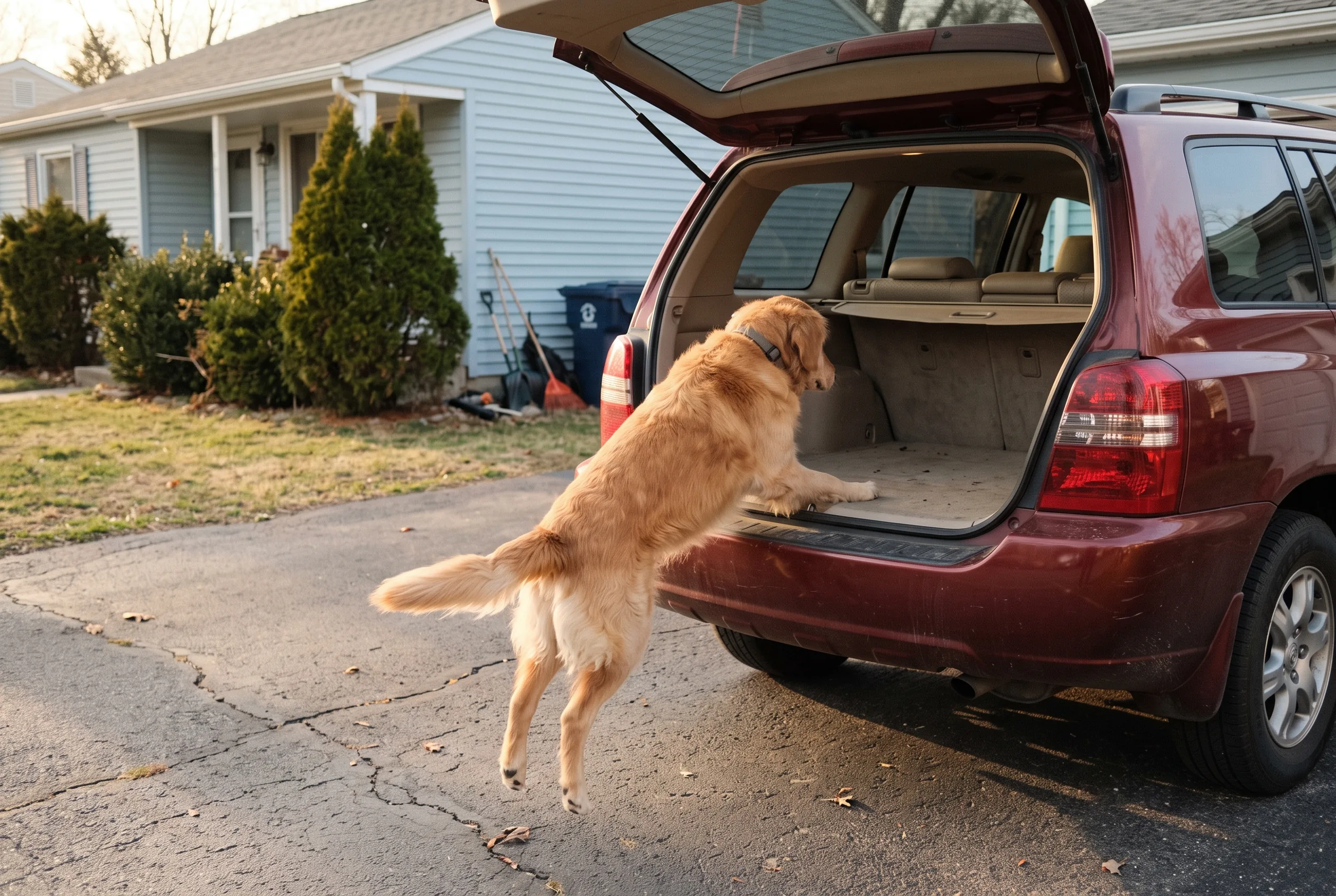
And you don’t care about his joints as anatomy. You care about what they let him do. Get up when the leash comes out. Follow you upstairs at bedtime. Jump into the car because he knows where it goes. Play for more than a minute.
If a few extra pounds are making every one of those harder, then taking them off sits right next to the chew. It doesn’t compete with it.
That’s an easier idea to act on than hunting for one more supplement that finally works.
The Hardest Part Isn’t Knowing. It’s 6 pm.
Once an owner sees the second job, the first move is obvious. Scoop out less.
Then dinner gets harder than the supplement routine ever was.
The chew is easy. He loves the chew. The smaller bowl, he does not love. He finishes it in thirty seconds and looks up. He follows you to the couch. Someone in the house says he looks hungry. A treat appears.
Ten days in, the bowl has crept back up and nobody remembers deciding that.
“Feed less” is a correct instruction and a terrible plan. It fails where the people who love the dog are standing.
Make the Smaller Portion Look Like a Meal
Think of soup. A big bowl of broth-based soup fills you up on fewer calories than a small plate of crackers. Water and fiber take up room.
Do that in his bowl and the fight is over. Less kibble, more in the bowl. He eats a full dinner. You fed him less. Nobody has to be the bad guy.
Owners have been doing a rough version of this for years with green beans and canned pumpkin. It works. It’s also unmeasured, the beans get picked around, and too much pumpkin ends badly.
Four Things, or It Won’t Last a Month
- 1It adds volume without adding calories that matter. Water and fiber, not fat, not more kibble.
- 2It's measured per pound of dog. “A handful” is not a plan. A scoop per 22 pounds is.
- 3The dog wants it. If he picks around it, it’s a standoff, not a diet.
- 4It works with the food he already eats. No brand switch, no new fight. Just a step added to the dinner you already make.
Green beans pass the first and fail the rest. Light kibble passes the second and fails the last two.
Not a Joint Product. A Bowl Product.
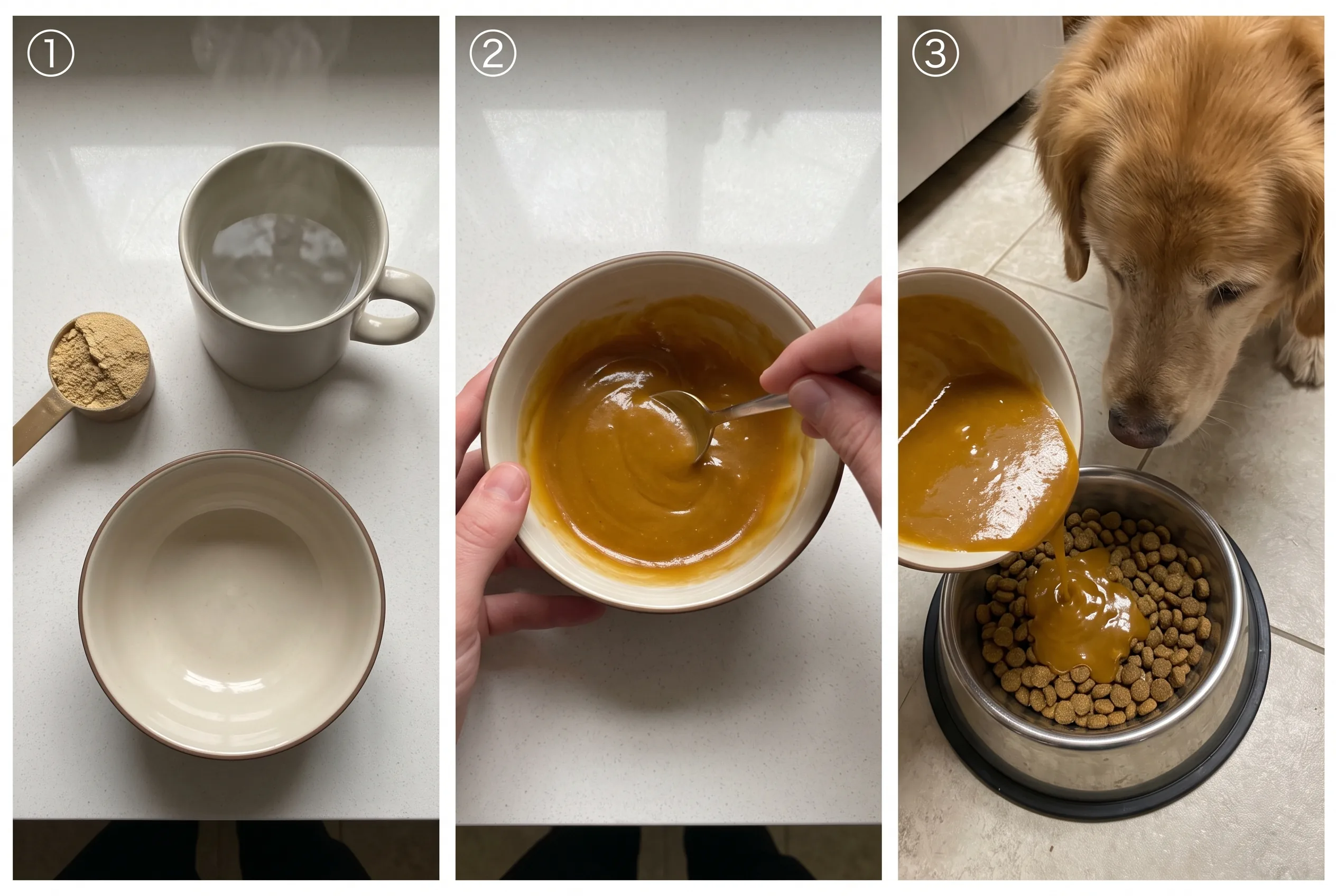
BOWLFUL is a powder. You mix one scoop with warm water, wait a minute or two, and it turns into a thick chicken gravy. You pour that over a smaller portion of the kibble your dog already eats.
It is not a joint chew. It doesn’t do the first job. Your chew stays exactly where it is.
Here’s how it handles the second job, against my four tests:
- Volume without calories that matter. The gravy is mostly water and fiber. About half the powder is fiber, from gum arabic, pea fiber, psyllium husk and beet pulp. Chicken broth and chicken liver are in there for taste.
- Measured. One scoop per 22 pounds of dog per day, split over two meals. A 600 gram can lasts a 22 pound dog about two months, a 44 pound dog about a month.
- He’ll want it. It tastes like chicken gravy, because that’s mostly what it is.
- Works with his food. Nothing gets switched. You feed less of it and pour this over the top.
The honest part. BOWLFUL does not make a dog lose weight by itself. Feeding less kibble does that. BOWLFUL is what makes feeding less something you can keep doing past day ten, because the bowl still looks like dinner.
So the morning routine stays. Chew with breakfast. The evening routine changes. Less kibble, gravy over the top. Two jobs, both done.
What to Expect, Week by Week
- 1
Week 1
His usual portion plus the gravy. Nothing on the scale yet. He’s learning the new bowl. Most dogs take to it at the first meal.
- 2
Week 2
Kibble comes down one step. Bowl still looks full. This is where the old diet broke. It won’t, because the bowl didn’t shrink.
- 3
Weeks 3 to 4
Kibble down another step, up to 15 percent less than where you started. First weigh-in. A safe pace is 1 to 2 percent of his body weight a week, so a 70 pound dog loses roughly a pound a week. Slow is correct.
- 4
Weeks 5 to 8
The routine runs itself. Whoever does breakfast does the chew. Whoever does dinner does the gravy.
If the scale hasn’t moved by week 4, the calories are hiding somewhere. The dental chew. The pill pocket. The plate. Look there first.
What Owners Tell Me
These are owners who gave me permission to share their numbers.
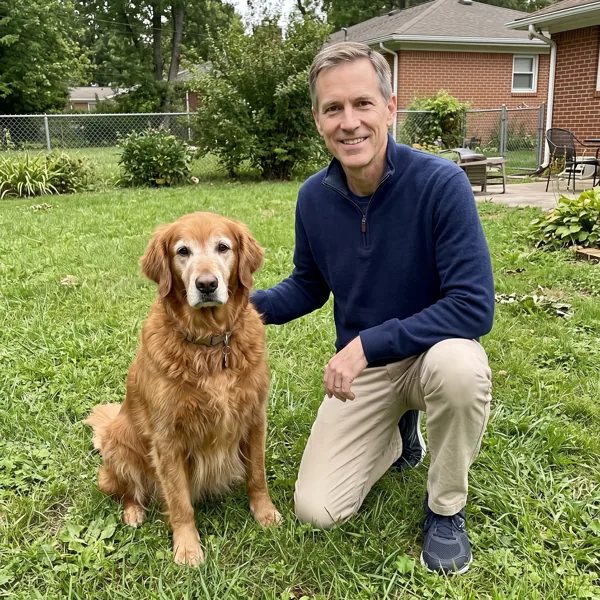
James and Bailey
Golden Retriever, 9
“I still give him the chew. I just realized that wasn’t the whole problem.”
91.3 lb to 88.6 lb in 7 weeks · still on his joint chew · gets up more easily
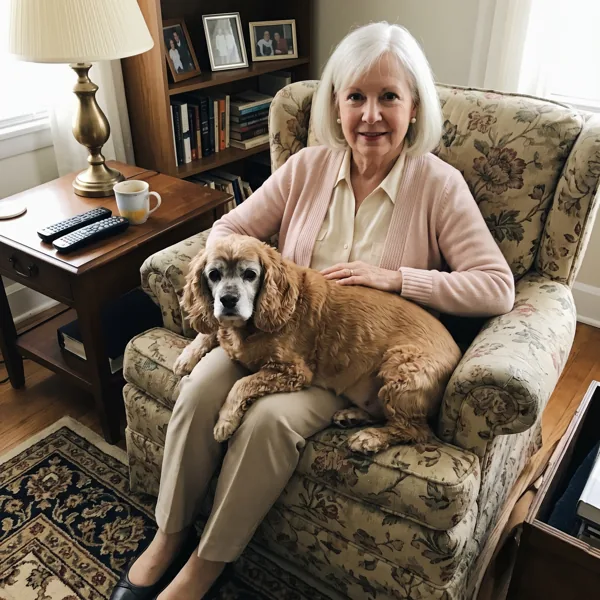
Carol and Molly
Cocker Spaniel mix, 11
34.6 lb to 32.9 lb in 9 weeks · walks to the leash on her own again and takes the stairs
Questions Before You Start
Should I stop the glucosamine?
No. Nothing here replaces it. This is the other job.
Won't a topper add calories?
Peanut butter does. Cheese does. BOWLFUL is mostly water and fiber, and the calories are counted in the plan.
More fiber, more poop?
It can, if you go from nothing to a full scoop on day one. That’s why week 1 is gradual. Most owners see normal, firmer stools.
He's picky.
The base is chicken broth and chicken liver. If he won’t eat chicken, this isn’t for him.
He's on pain medication.
Talk to your vet before you change how you feed him. Bring the plan with you. Most vets will be glad you asked.
Can't I just do green beans?
You can. Same idea. BOWLFUL is measured, tastes like something and doesn’t get picked around. Most owners who tried the beans already know why that matters.
Who This Is For, and Who It Isn’t
For:
- dogs on a joint routine who failed two of the three checks
- dogs who are slow to get up and a few pounds heavy
- households with more than one feeder
Not for:
- puppies
- pregnant or nursing dogs
- underweight dogs
- dogs on a prescription diet for a diagnosed condition unless your vet says yes
- dogs allergic to chicken
Keep the Chew. Check the Bowl.
You’ve been doing one job carefully for years. Good. Don’t stop.
Now stand over him tonight and look for the waist. If it’s there, you’re done. If it isn’t, the other half of joint care is in the food bowl, and it doesn’t cost another jar.
Less kibble. Full bowl. Weigh him in a month.
Evidence Sources
- Roush JK et al., Evaluation of the effects of dietary supplementation with fish oil omega-3 fatty acids on weight bearing in dogs with osteoarthritis, Journal of the American Veterinary Medical Association, 2010;236:67-73. 38 dogs, 90 days: PubMed
- Marshall WG et al., The effect of weight loss on lameness in obese dogs with osteoarthritis, Veterinary Research Communications, 2010;34:241-253. 14 dogs, improvement from about 6.1 percent body weight lost: PubMed
- Impellizeri JA et al., Effect of weight reduction on clinical signs of lameness in dogs with hip osteoarthritis, Journal of the American Veterinary Medical Association, 2000: PubMed
- Kealy RD et al., Effects of diet restriction on life span and age-related changes in dogs, Journal of the American Veterinary Medical Association, 2002: PubMed
- Cornell Riney Canine Health Center, safe weight-loss rate of 1 to 2 percent of body weight per week: Cornell
These studies support the general discussion of joint support and body weight in dogs. They are not studies of BOWLFUL, and nothing on this page is a treatment for arthritis or lameness.