
Advertorial · Updated August 21, 2026 · 8 minute read
DOG HEALTH • HEALTHY WEIGHT
Why “Just 4 Extra Pounds” Can Be a Big Deal on a Small Dog
Three or four pounds sounds small when you think like a human. On a much smaller body, the same number can mean something very different.
Author’s note: When I discuss weight with dog owners, one of the most common reactions I hear is that a few extra pounds do not sound like much. In this article, I want to put that number into the context I use as a veterinarian: the size of the dog carrying it and the daily movement that body performs.

By Dr. Daniel Whitmore, DVM
Veterinarian focused on senior canine health and healthy aging · August 21, 2026 · 8 min read
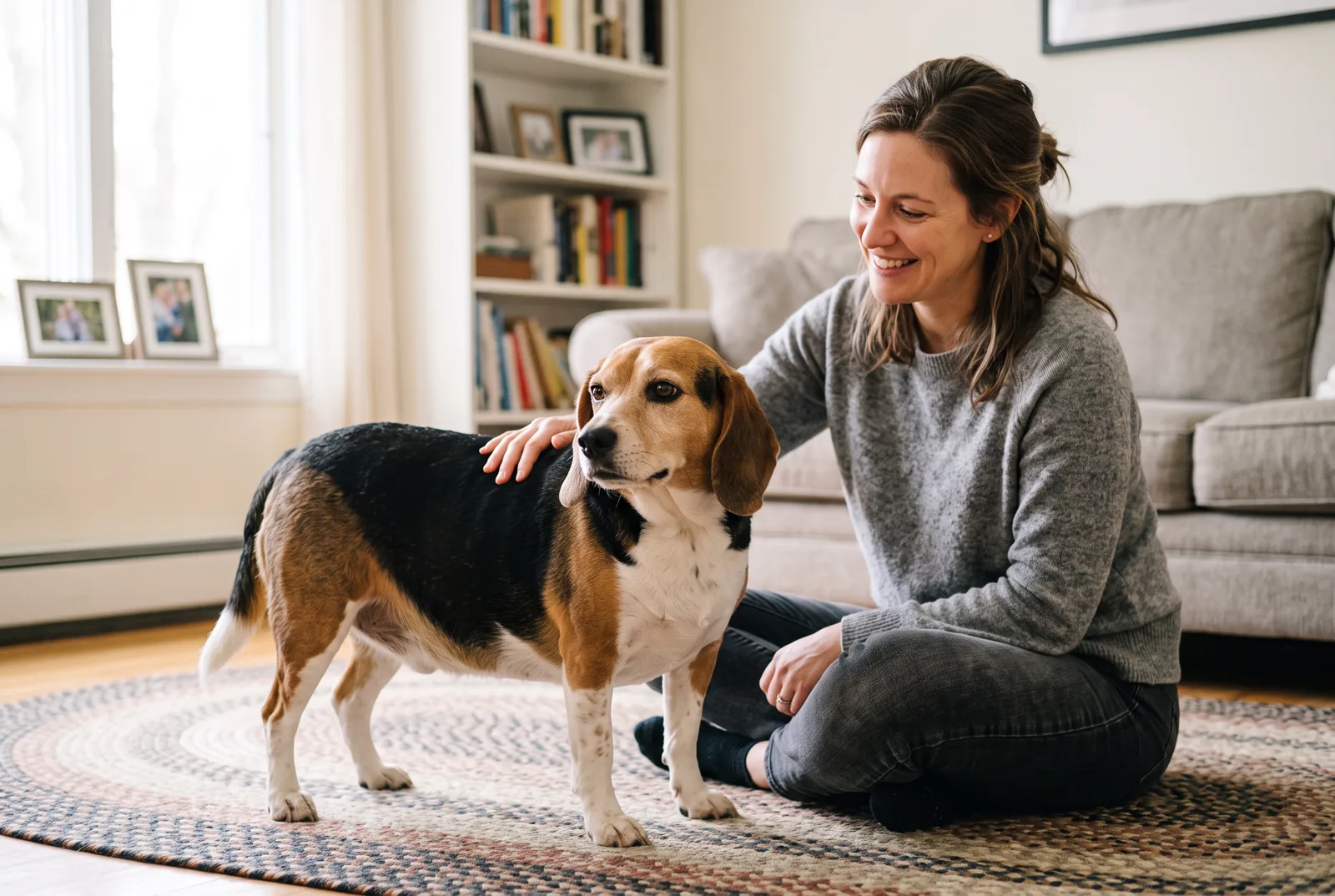
Most owners who know their dog is a little overweight do not deny it.
They simply do not feel much urgency.
“He could lose a few pounds.”
“He is a little chunky.”
“The vet said he should slim down a bit.”
The language sounds harmless because the number sounds harmless.
A few pounds does not feel like much.
But there is one problem with judging your dog’s weight that way:
You are comparing the number to your body, not his.
And once you stop looking at the number by itself, the picture changes quickly.
The Number Only Makes Sense in Context
Imagine two people each gain four pounds.
For a large adult human, that may represent a very small percentage of total body weight.
For a dog that weighs a fraction of that, the same four pounds can represent a much more meaningful change.
That is the reframe most owners rarely make, so let me put an actual number on it.
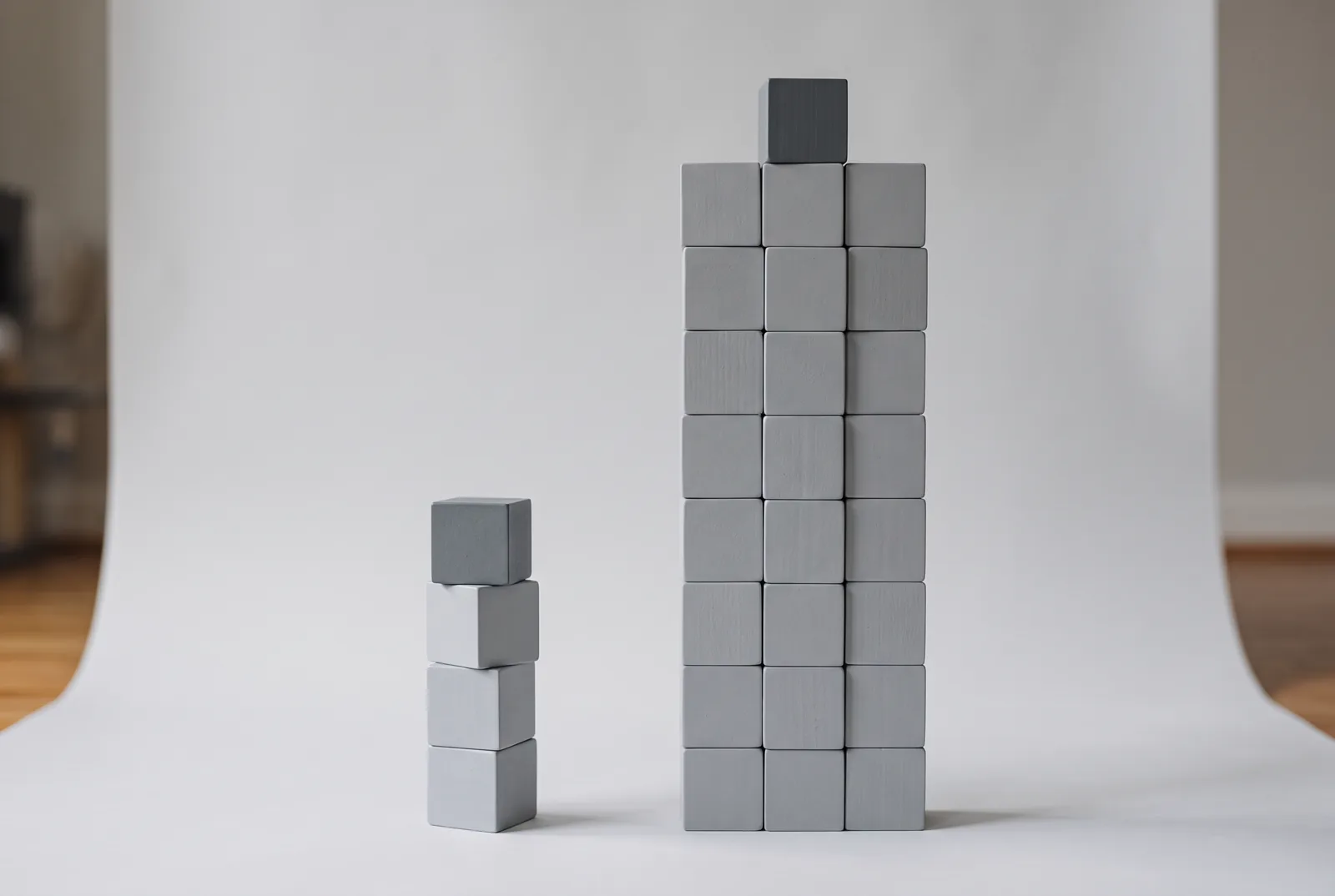
Four extra pounds on a 20 pound dog is 20% of his body weight.
For perspective, 20% of a 175 pound adult is 35 pounds.
That does not mean dogs and humans carry weight identically. It means the phrase “only four pounds” is meaningless until you divide it by the size of the body carrying it.
When I hear “it is only a few pounds,” this is the calculation I want an owner to see first. A dog does not carry an abstract number. He carries a percentage of his body through every ordinary day.
Your Dog Carries Them Through Every Part of His Day
The number on the scale is easy to ignore because it sits still.
Your dog does not.
He carries his body when he gets up from the floor.
He carries it down the hallway.
He carries it on every walk.
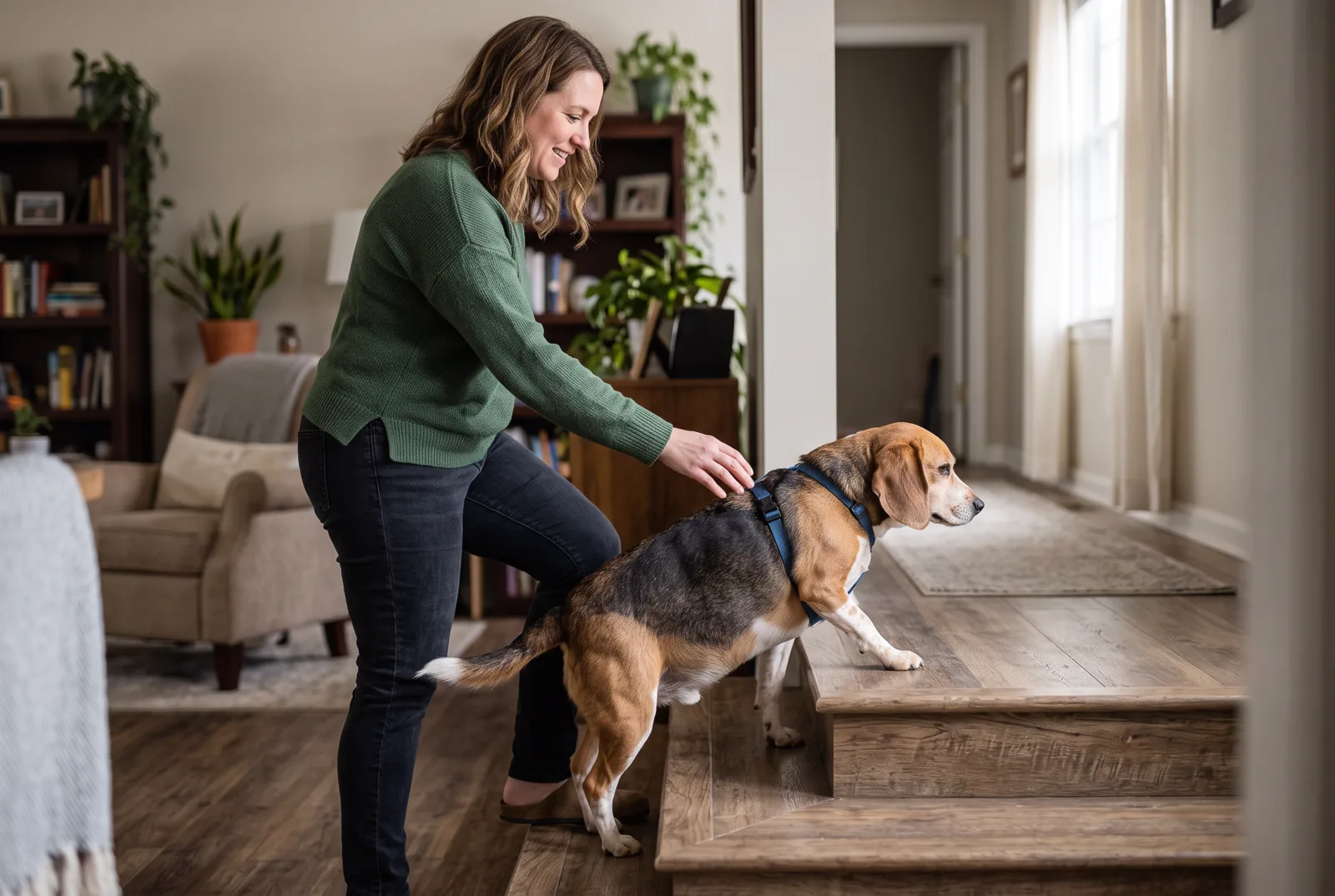
He carries it up stairs.
He carries it when he turns during play, jumps into the car or follows you into another room.
That is why excess weight is not mainly an appearance problem.
It is a daily load problem.
And daily load repeats itself thousands of times through ordinary life.
The question is not whether your dog looks dramatically overweight.
The better question is:
Is he carrying more body than he needs to through every movement he still wants to make?
“He Is Only a Little Overweight” Is an Easy Problem to Postpone
There is rarely one dramatic moment that forces action.
The dog still eats.
He still gets excited for walks.
He still looks happy.
So weight management gets moved to next week, next month or after the holidays.
The problem is that later has no start date.
And the routine that created the extra weight keeps happening while the decision gets postponed.
The same scoop.
The same treats.
The same evening chew.
The same handful added because the bowl looked small.
Nothing feels serious enough to change today.
That is how “just a few pounds” can quietly become the new normal.
The broader prevalence data shows why this matters. In the Association for Pet Obesity Prevention’s 2022 U.S. survey, 59% of dogs were classified as overweight or having obesity. When excess body condition is this common, “a little heavy” can start to look ordinary. The percentage calculation is what turns ordinary back into measurable.
The Goal Is More of the Life He Already Loves
Most owners do not care about a perfect waistline.
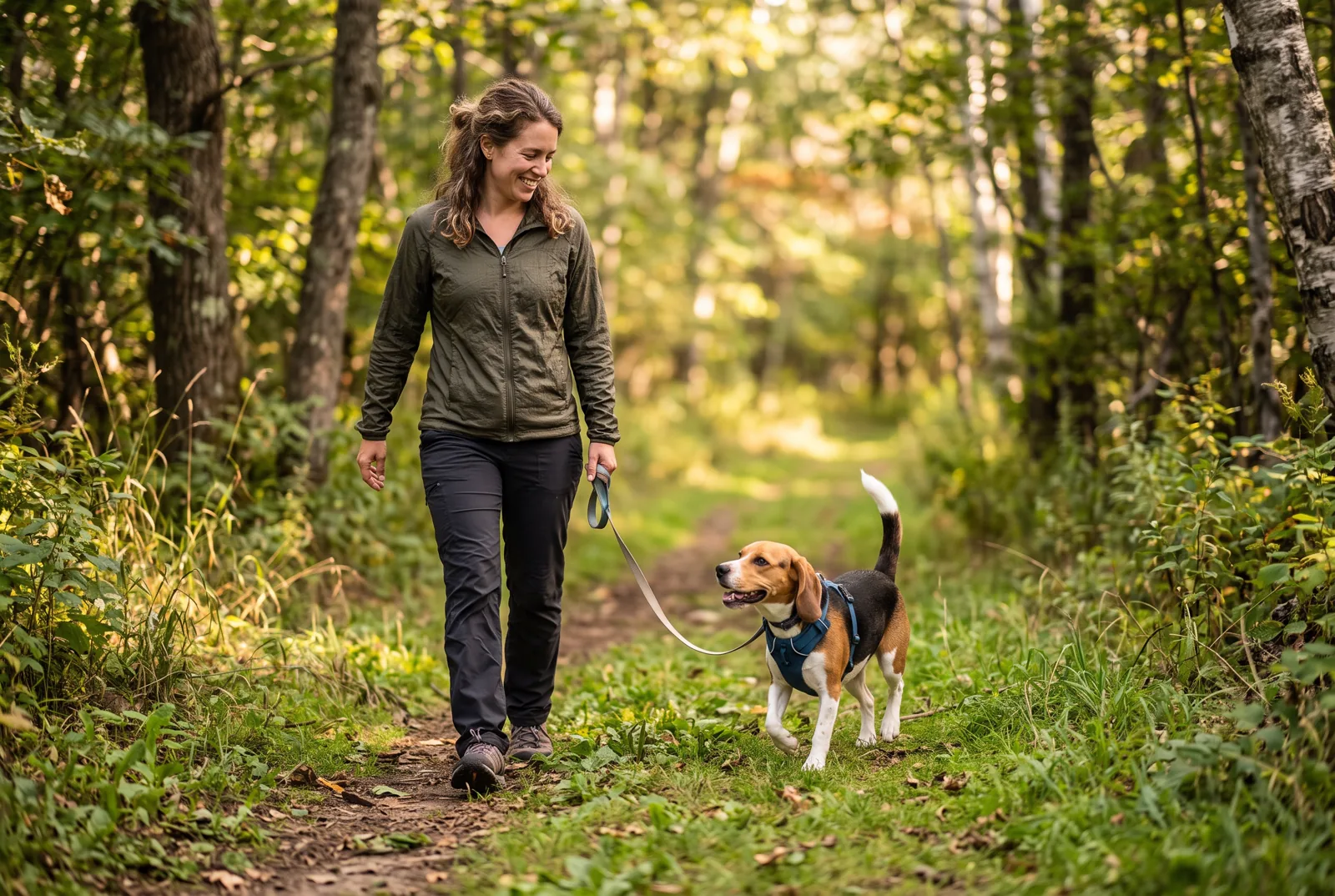
They care about the dog waiting at the door for a walk.
The dog following the family upstairs.
The dog still wanting another throw of the toy.
The dog getting into the car because he knows something fun is about to happen.
That is the useful reason to care about body condition.
Not because a leaner dog looks better in a photo.
Because a healthier body is part of the bigger picture of everyday participation.
Why the Things Owners Usually Try Keep Breaking Down
By the time an owner reaches this point, “feed less” is rarely a new idea.
I hear the same failed attempts repeatedly: switch to a light kibble, cut treats for a week, add a longer walk, eyeball a smaller scoop, skip the evening chew, then slowly drift back because the dog still acts hungry and the household has no shared system.
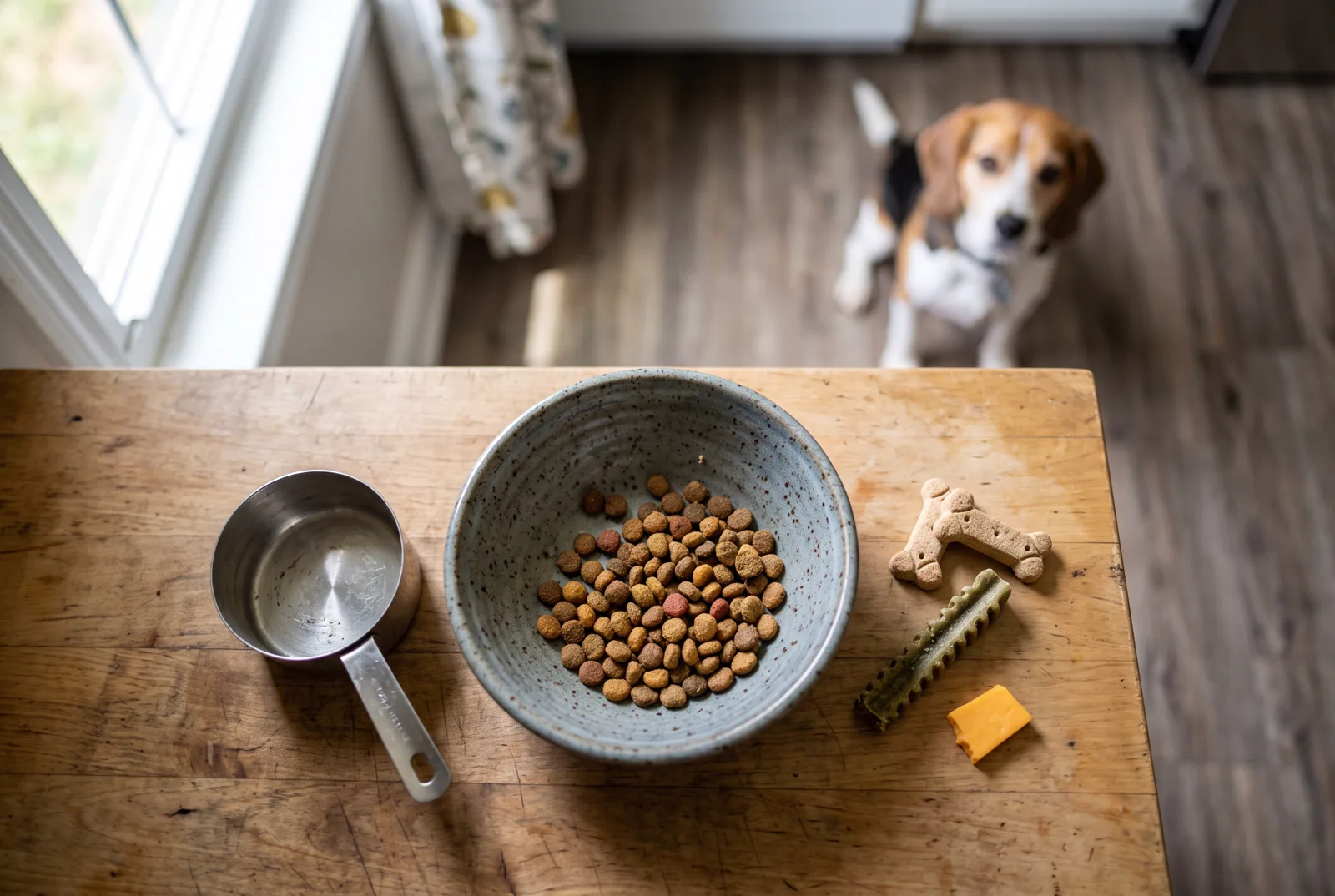
The hardest moment is not understanding the calorie math. It is standing over a visibly smaller bowl while your dog stares at you as if dinner has been stolen.
Then comes the whining. The kitchen following. The child who slips him something because “he is still hungry.” The extra handful because the bowl looks wrong.
That moment has a name in my mind: the empty bowl problem.
A plan can be mathematically correct and still fail if it creates guilt at every meal. That is why the next step is not simply removing more. It is rebuilding the meal so the calorie reduction has a routine around it.
Use the Same Principle That Makes a Bowl of Soup Feel Bigger Than Its Calories
Human nutrition uses a simple idea called energy density: foods with more water and volume can occupy more space for fewer calories than the same visual volume of calorie dense food. Think of the difference between a small dry snack and a bowl of broth based soup.
The same principle gives me a useful way to explain the feeding problem here. The calorie reduction still has to come from reducing the calorie dense base food. Water, fiber and added physical volume do not cancel calories. They help change what the new meal looks and feels like in the bowl.
For a dog whose “few extra pounds” are actually a meaningful percentage of body weight, that distinction matters. The plan needs a measurable calorie lever and a meal format the household can repeat without renegotiating dinner every night.
The Structured Approach I Looked At: BOWLFUL by Holypup
BOWLFUL by Holypup takes a different approach from simply making the portion look smaller.
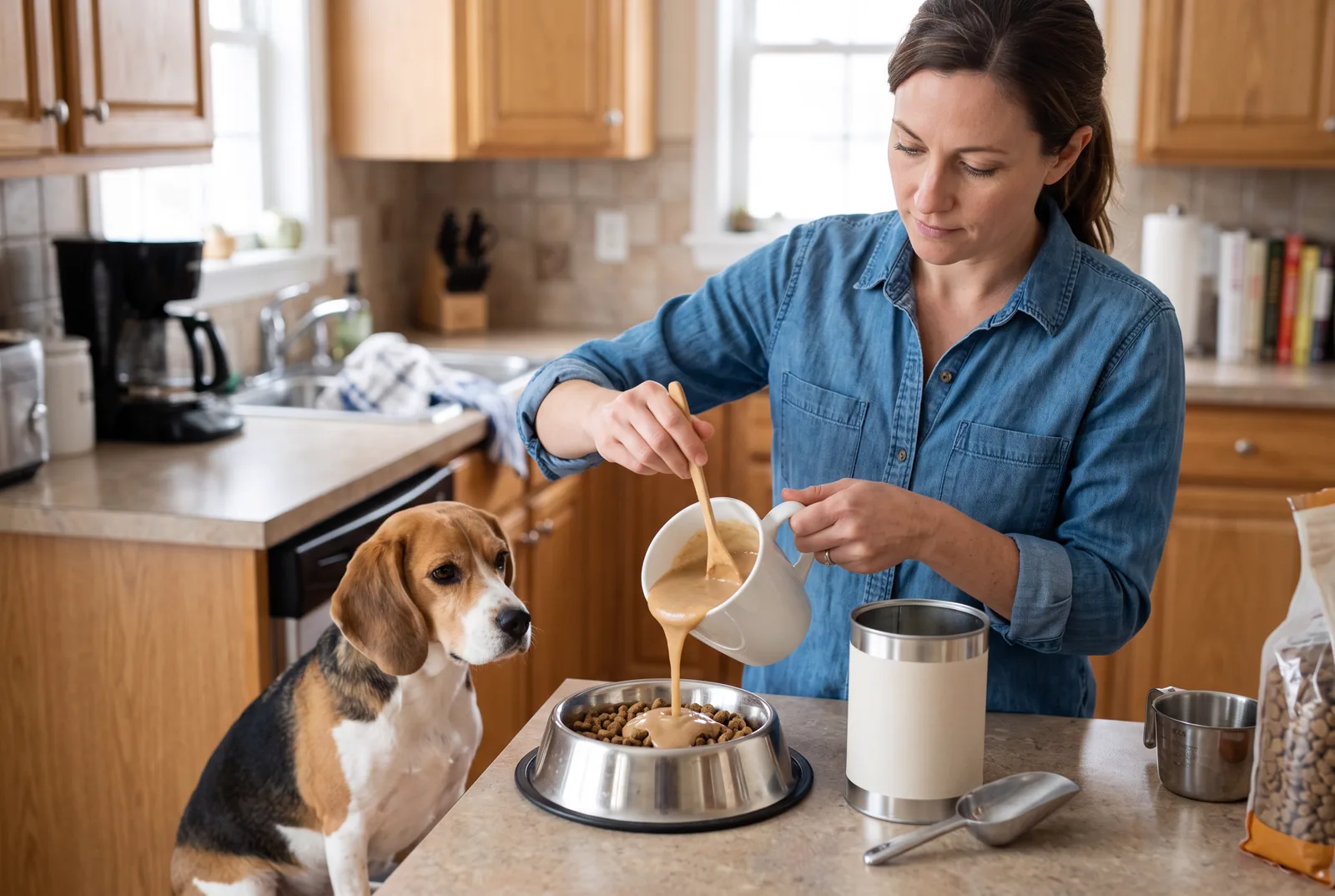
It starts as a fiber-rich powder. The measured serving is mixed with warm water, left for one to two minutes to thicken, then stirred into the dog’s regular food as a gravy.
That matters because the product is designed around two things owners can see and repeat: water and volume in the bowl.
The formula contains 49% total dietary fiber, with fiber sources including gum arabic, pea fiber, psyllium seed husk and dried beet pulp. Chicken broth and chicken liver meal are also part of the formula.
The feeding plan is phased rather than abrupt. BOWLFUL is introduced gradually, then used at the full serving while the dog’s regular food portion is reduced step by step, up to 15% in the standard plan.
49% fiber: nearly half of the powder by weight is dietary fiber, then water turns that fiber-rich serving into more physical volume in the bowl.
Up to 15% less base food: sustained for 12 weeks, a 15% daily reduction equals the amount of regular food contained in about 12.6 full daily portions, before accounting for BOWLFUL, treats or any other calorie changes.
Timeline: Week 1 introduces the new bowl → Week 2 establishes the full serving → Week 4 has the reduced-base-food routine underway → Week 8 is about making the measured plan feel normal.
That distinction is important:
The reduction in regular food is the calorie lever. BOWLFUL is the tool designed to make that smaller portion into a fuller, more structured meal.
It does not make calorie balance irrelevant. It gives the owner a defined ritual to repeat instead of relying on an increasingly vague instruction to “feed a little less.”
A Few Pounds Can Be Easy to Ignore. A Clear Plan Is Harder to Put Off.
If you already know your dog could lose some weight, you do not need another lecture about the problem.
You need to decide whether “a few pounds” is still something you are comfortable postponing.
Because on a smaller body, the number may mean more than it sounds like.
And every ordinary day gives that body another full day of movement to carry.
The good news is that this is not an abstract problem.
It is a routine problem.
And routines can be changed.
Next Step
If you want to see exactly how BOWLFUL by Holypup is designed to fit into this structured feeding approach, the next page explains the product, the phased feeding plan, current purchasing options and available plans.
The commercial offer lives on the dedicated Offer Page, not inside this advertorial.
Evidence Sources
- Association for Pet Obesity Prevention, 2022 U.S. Pet Obesity Prevalence Survey: APOP survey summary
The prevalence source supports the editorial context that excess body condition is common. The 4 pound example is simple percentage arithmetic, not a medical claim. This source is not a study of BOWLFUL.