
Advertorial · Updated August 21, 2026 · 8 minute read
DOG HEALTH • EVERYDAY MOBILITY
Your Dog’s Joints May Not Be the Whole Problem
When a dog starts moving differently, most owners look straight at the joints. That makes sense. But the joints are only one side of every movement. The other side is the body they have to move.
Author’s note: In veterinary conversations about mobility, I often see owners focus understandably on the joints themselves. In this article, I want to explain why I also look at the load those joints move every day and why body condition belongs in the same conversation.

By Dr. Daniel Whitmore, DVM
Veterinarian focused on senior canine health and healthy aging · August 14, 2026 · 8 min read
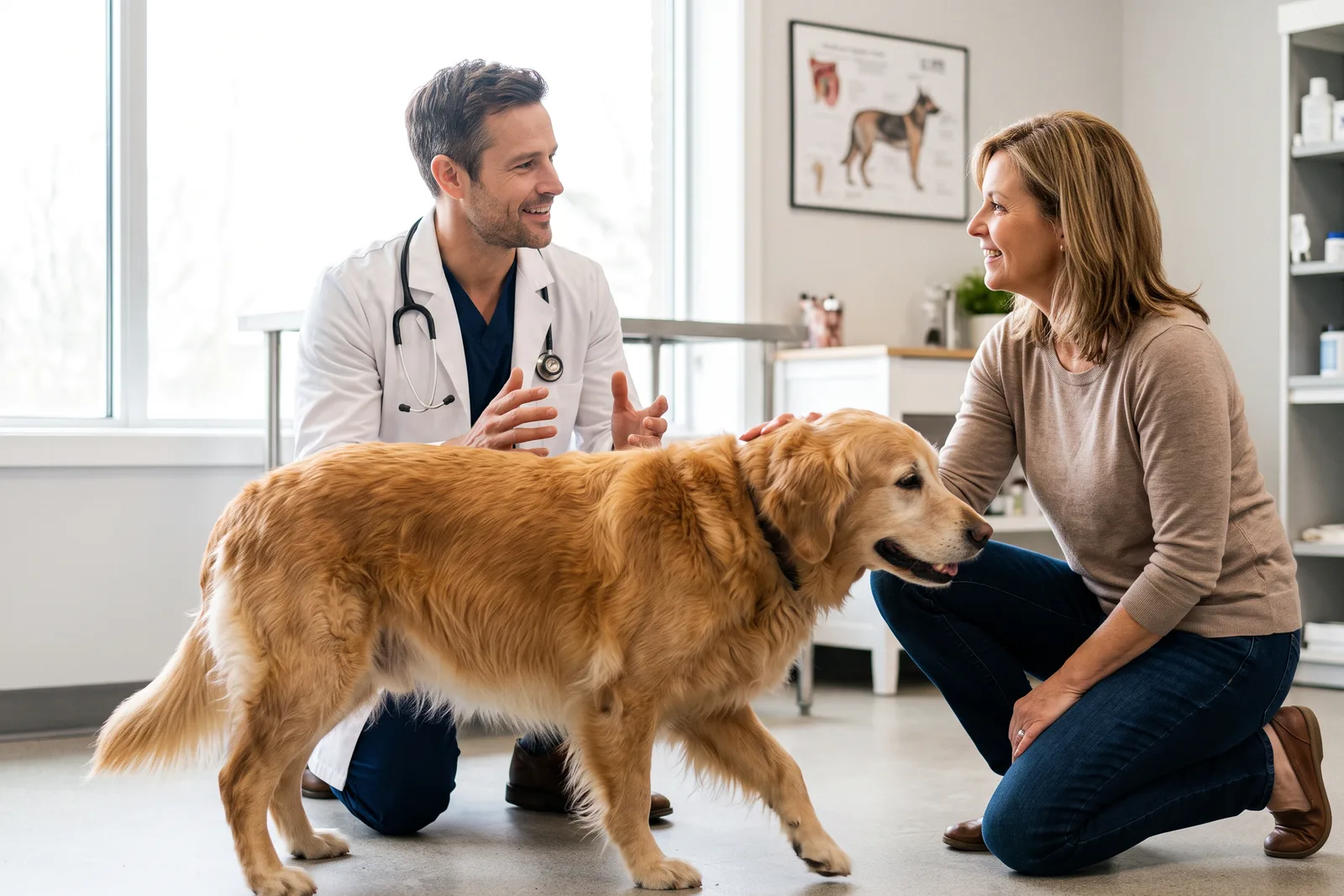
A dog takes longer to get up after a nap.
He pauses before jumping into the car.
The stairs become less automatic.
The evening walk gets shorter.
Naturally, owners start thinking about the joints.
Maybe they need more support.
Maybe age is catching up.
Maybe a joint chew, ramp or supportive bed would help.
That is a reasonable place to start.
But there is a second question that gets asked far less often:
How much body are those joints moving every single day?
That question changes the entire frame.
We Notice the Structure That Is Doing the Moving
Joints bend when the dog gets up.
They absorb movement during a walk.
They are involved in stairs, turns, jumps and play.
So when those movements begin to look different, the joint becomes the obvious suspect.
But every movement has two parts.
There is the structure doing the work.
And there is the amount of body that structure has to move.
Most owners think deeply about the first part and almost never about the second.
Support and Load Are Not the Same Thing
Imagine wearing a backpack from the moment you get out of bed.
You carry it down the hallway.
You take it on every walk.
You keep it on for every stair.
You stand up with it.
You sit down with it.
You turn, climb and move with it all day.
The backpack does not have to feel enormous for the extra load to repeat itself through every movement.
Your dog is not carrying a backpack.
But he is moving his full body weight through the same joints, again and again.
That does not mean body weight explains every mobility issue. It means load belongs in the conversation too.
And this is not only a mechanical thought experiment. In a prospective 16 week study of 14 obese dogs with osteoarthritis, weight loss alone was associated with significant reductions in lameness. Subjective improvement appeared from about 6.1% body weight reduction, while kinetic gait analysis supported improvement from about 8.85%.
That study was not a study of any weight-management product and it does not turn weight loss into a treatment for every mobility problem. It does give us something more useful than a vague statement: in dogs already carrying excess weight and diagnosed with osteoarthritis, modest weight reduction measurably changed how they moved.
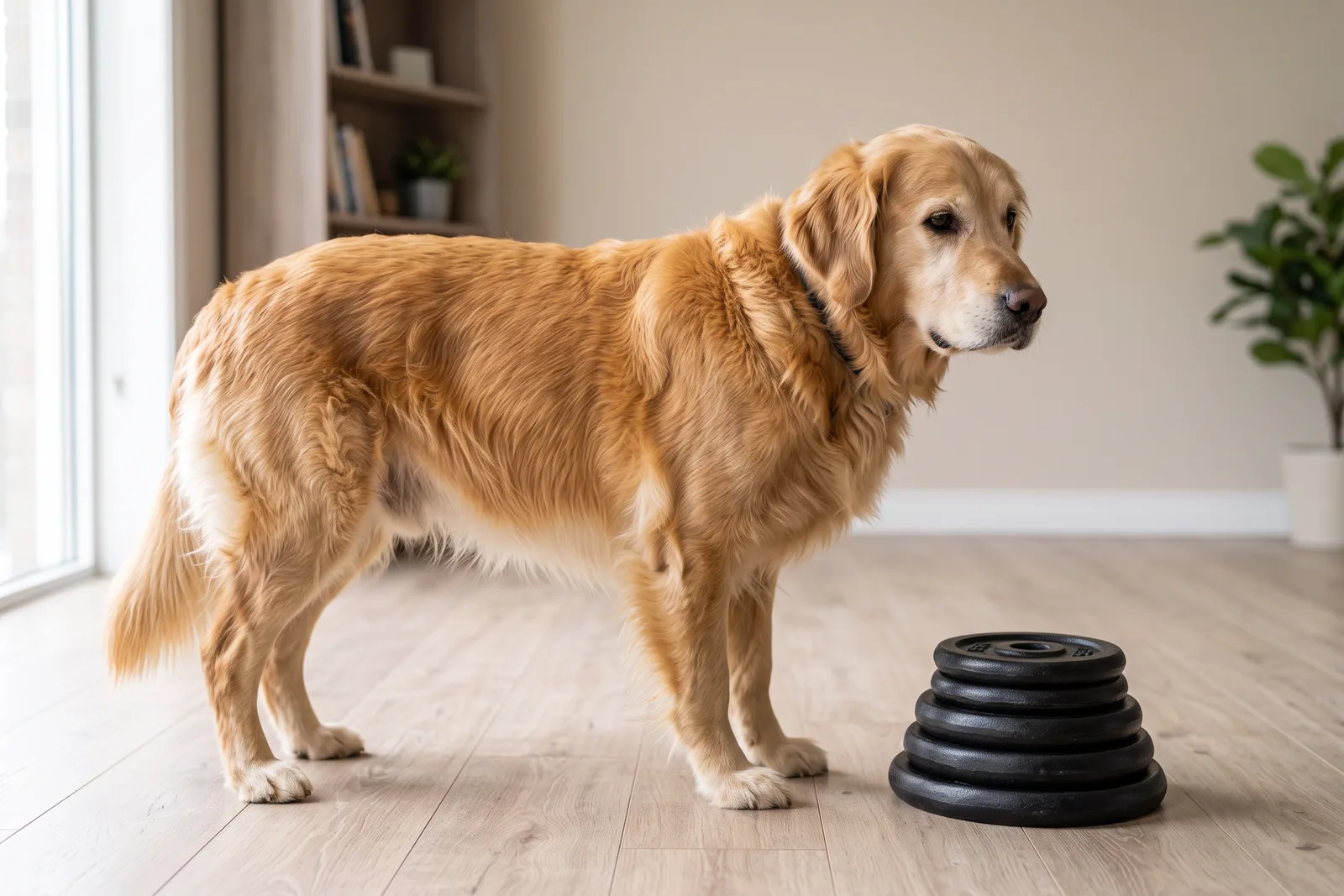
Extra Body Weight Rarely Arrives Dramatically
A dog usually does not become visibly heavier overnight.
The waist softens a little.
The ribs become a little harder to feel.
The body becomes a little rounder.
And because the owner sees the same dog every day, the new shape becomes familiar before it becomes alarming.
That is why body condition is more useful than asking, “Does he look overweight?”
A Simple At-Home Check
Look from above. Is there a waist behind the ribs?
Feel the ribs. Can you feel them easily without pressing hard?
Look from the side. Is there an upward abdominal tuck?
If those three observations make you look twice, body condition deserves more attention than it may have been getting.
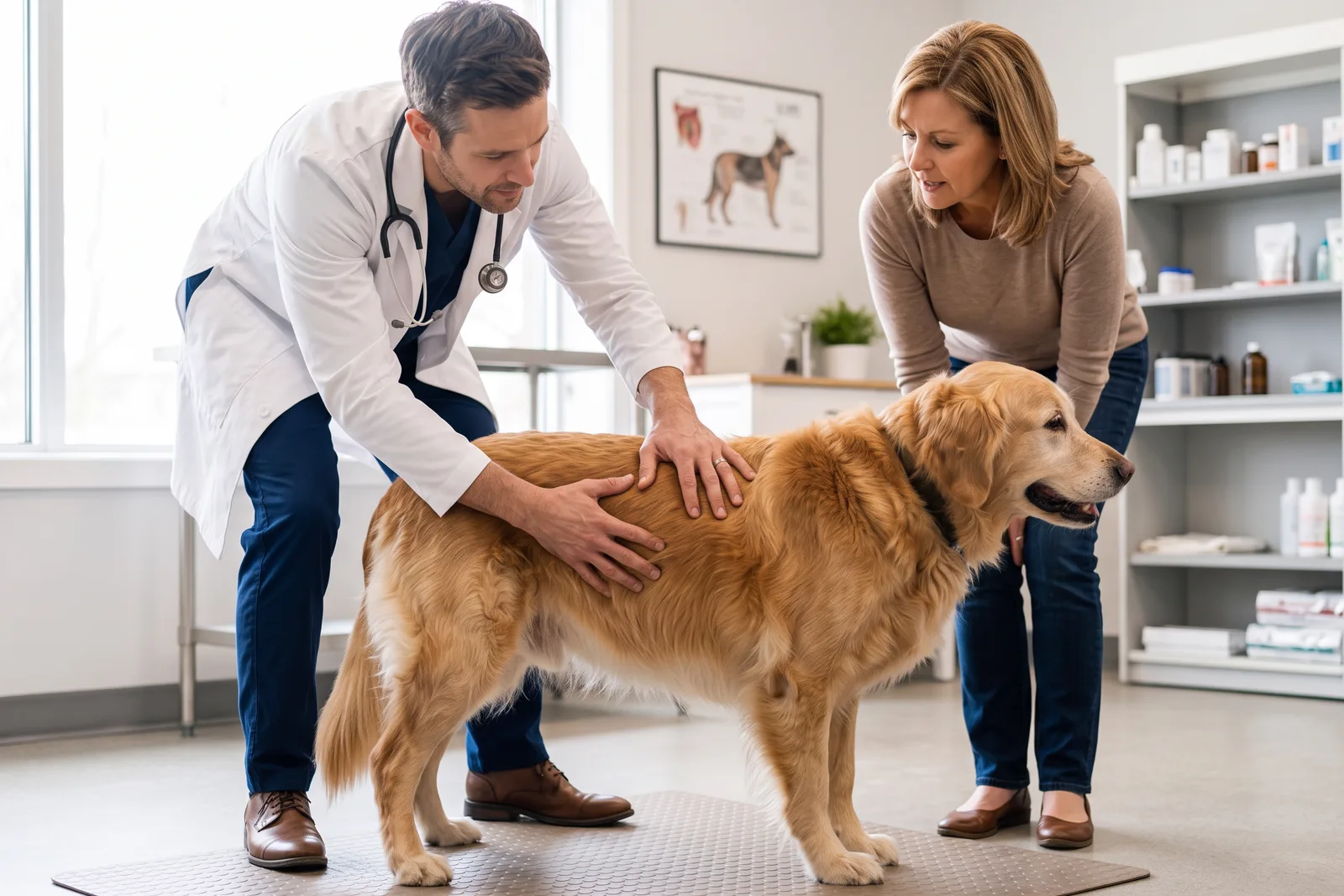
The Dog Carries the Result Through Every Ordinary Movement
If a dog is above an appropriate body condition, that extra body does not sit somewhere separate from daily life.
It moves through the same joints every time the dog stands up.
Every time he climbs.
Every time he turns.
Every time he walks.
Every time he jumps.
That is why healthy body condition is not simply a cosmetic issue.
It is part of the broader physical picture of everyday movement.
And once you see support and load as separate levers, the question becomes much more useful:
Are we only supporting the structures, or are we also looking at what those structures have to carry?
Protecting the Walk Means Looking Beyond the Joint
Owners do not really care about joints as isolated anatomy.
They care about what those joints allow the dog to do.
Get up when the leash comes out.
Follow the family upstairs.
Step into the car.
Walk the familiar route.
Play without stopping after a minute.
That is why body condition can matter so much emotionally.
The goal is not to chase a perfect silhouette.
The goal is to remove unnecessary load from the ordinary moments owners want their dog to keep enjoying.
Why More Joint Support Does Not Solve the Load Side
When mobility changes start, owners understandably collect tools for the joint side of the equation: a joint chew, fish oil, a ramp, a supportive bed, fewer stairs, shorter walks.
Some of those can be useful in the right dog. But none of them changes the amount of body the dog has to move.
Then owners finally turn to food and run into a different problem. The measured portion looks too small. The dog looks back at them. Someone adds a treat because dinner feels unfair. Another person feeds again because nobody knows what was already given.
So the load problem survives, not because the owner does not care, but because the feeding plan creates friction twice a day.
That is why I separate the two jobs clearly: support the joint where appropriate, and build a separate routine for the load.
Build a Larger Looking Meal Around a Smaller Calorie Base
Think of the difference between a compact dry snack and a bowl of broth based soup. The soup can take up far more physical space because water contributes volume without behaving like calorie dense dry food.
That is the useful analogy here. The calorie lever remains the deliberate reduction in the regular food. Fiber and water are used to build more physical meal around that reduced base.
For the joint load angle, this matters because the feeding routine is the mechanism that can actually change the load over time. The product should not pretend to support the joint. It should make the separate load management job easier to execute.
BOWLFUL by Holypup: A Feeding Tool for the Side Joint Products Cannot Change
BOWLFUL by Holypup is not a joint treatment. Its role is on the other side of the mobility conversation: the feeding routine that shapes body condition over time.
BOWLFUL starts as a fiber-rich powder and is prepared with warm water into a gravy. After one to two minutes of thickening, the prepared gravy is mixed into a measured portion of the dog’s regular food.
Its formula provides 49% total dietary fiber, with gum arabic, pea fiber, psyllium seed husk and dried beet pulp among the fiber sources. Preparing it with water also adds physical volume to the bowl.
The feeding plan is deliberately gradual. The product is introduced first, then the regular food portion is reduced in stages, up to 15% in the standard plan.
49% fiber: nearly half of the powder by weight is dietary fiber, which is then prepared with water to build physical meal volume.
Up to 15% less base food: at the full standard reduction, the regular calorie-dense food portion is meaningfully smaller every day rather than merely eyeballed down.
Timeline: Week 1 introduces the ritual → Week 2 establishes the full serving → Week 4 has the reduced-base-food routine underway → Week 8 is about repeating the same load-management feeding system consistently.
That keeps the mechanism clear:
BOWLFUL does not treat the joints and it does not make a dog lose weight by itself. Reducing the regular food portion is the calorie lever. BOWLFUL is designed to make that smaller portion into a fuller, more structured meal that is easier to repeat.
That is why I view it as a load management tool rather than a mobility supplement. One side of the plan can support the joint. This side changes what the joint has to carry.
So supporting a dog’s joints and addressing the load those joints carry remain two different jobs. BOWLFUL belongs to the second one.

Support the Joint. Then Look at What It Is Carrying.
Joint support and body-condition management are not competing ideas.
They solve different problems.
One focuses on the structure.
The other focuses on the load moving through it.
If your dog’s body condition is already appropriate, that is useful information.
If it is not, then weight management may be a lever that has been hiding in plain sight.
Next Step
The next page explains how BOWLFUL by Holypup is designed to fit into this structured feeding routine, including the phased plan, current purchasing options and available plans.
The commercial offer lives on the dedicated Offer Page, not inside this advertorial.
Evidence Sources
- Marshall WG et al., The effect of weight loss on lameness in obese dogs with osteoarthritis, Veterinary Research Communications, 2010: PubMed
- Impellizeri JA et al., Effect of weight reduction on clinical signs of lameness in dogs with hip osteoarthritis, Journal of the American Veterinary Medical Association, 2000: PubMed
These studies support the editorial discussion of excess body weight and mobility in overweight dogs with osteoarthritis. They are not studies of BOWLFUL and do not imply that BOWLFUL treats osteoarthritis or lameness.