
Advertorial · Updated August 21, 2026 · 11 minute read
DOG HEALTH • SENIOR DOGS
Is Your Dog Getting Old, or Just Heavy? 5 Ways to Tell
Shorter walks. A pause before the couch. More naps. Most owners call it age. A vet on the third answer nobody says out loud.
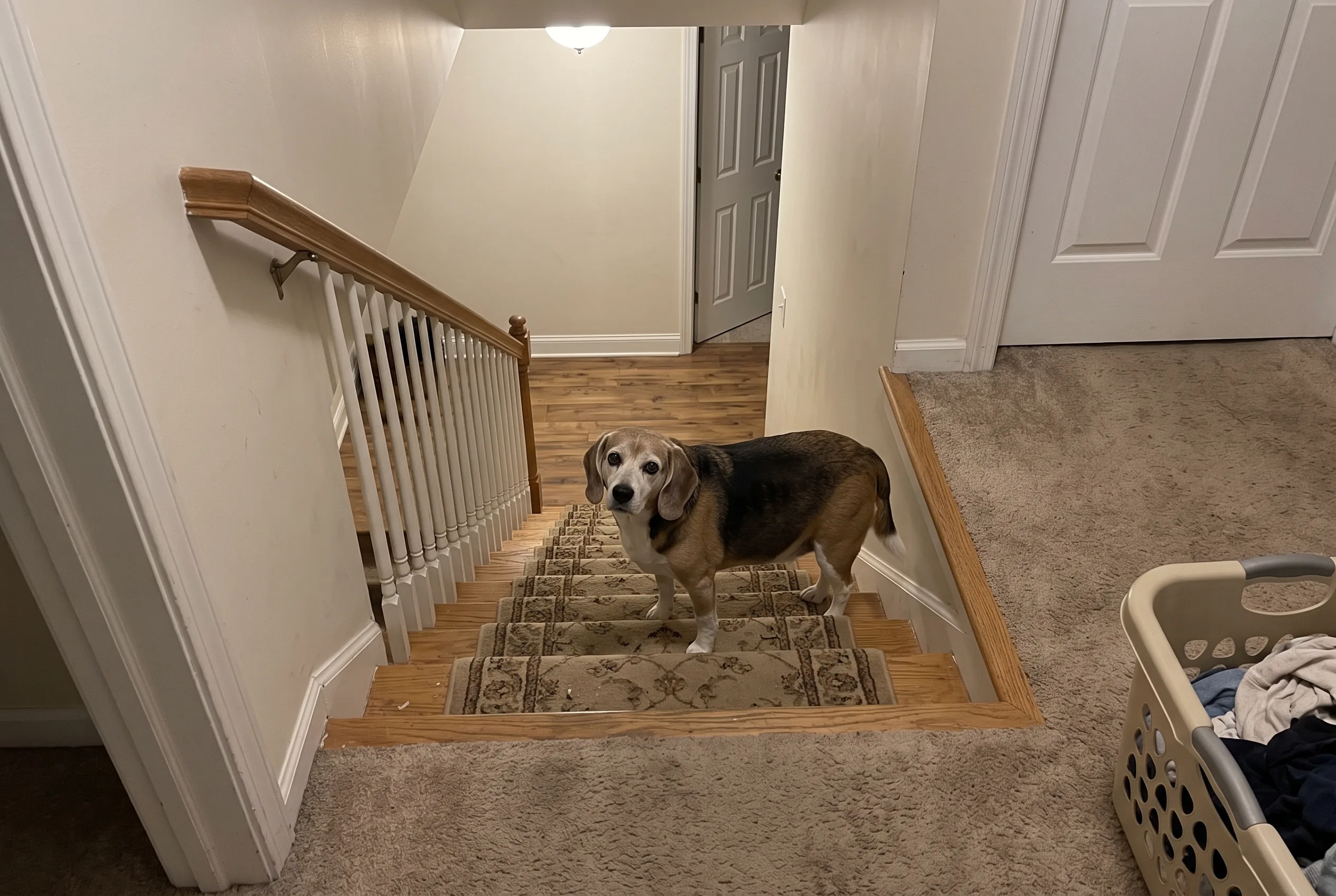
Author’s note: “Is she lazy, or just old?” is the question I hear most. Often the honest answer is neither. This is the answer I give.

By Dr. Daniel Whitmore, DVM
Veterinarian focused on senior canine health and healthy aging · August 21, 2026 · 11 min read
“He’s just getting old.”
It is the most natural thing a dog owner can say. And a lot of the time, it is true.
Older dogs sleep more. They play less. They stop tearing through the yard like they did at three.
But “he’s just old” has a problem. It ends the conversation too early.
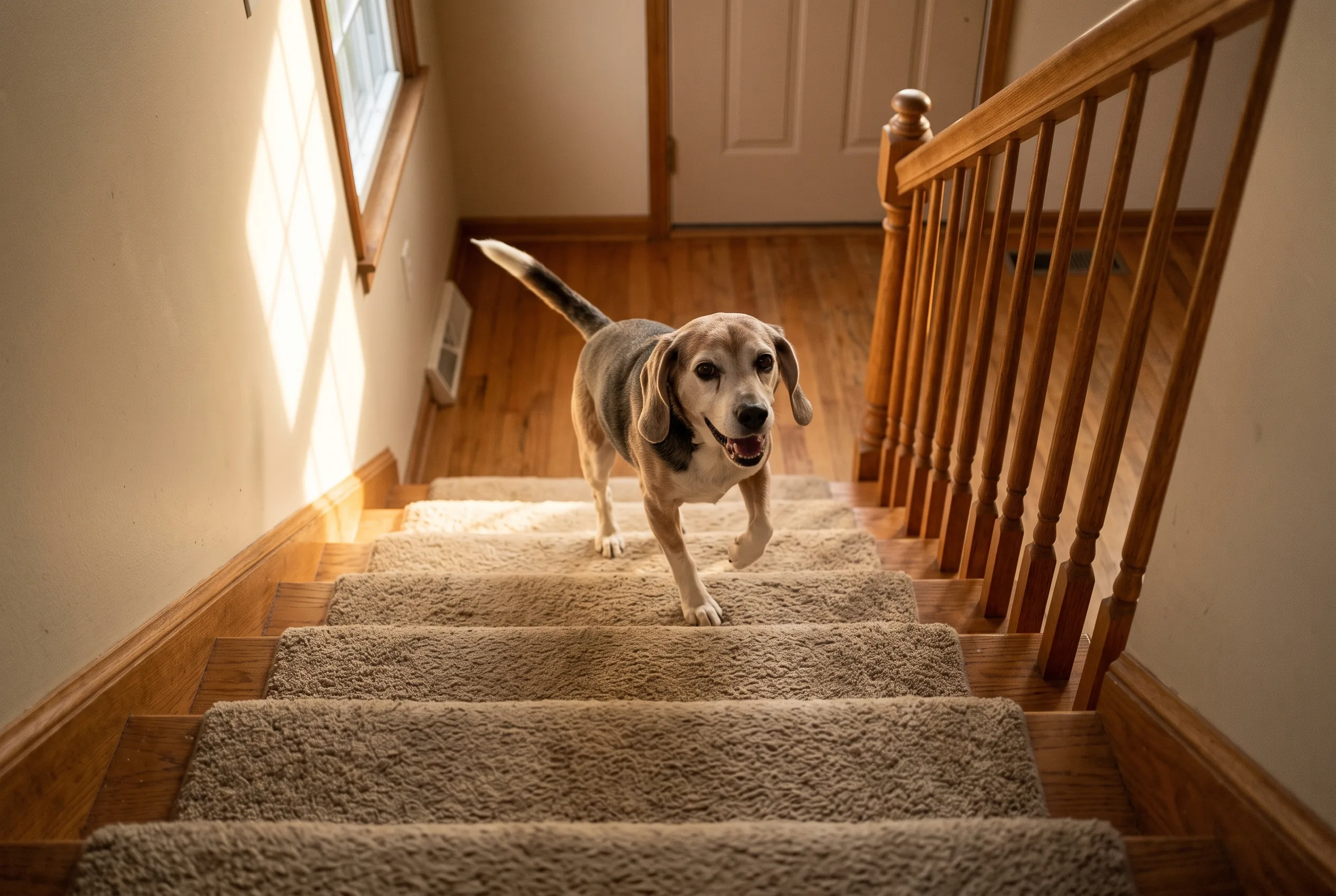
The walk gets shorter, so you change the route. The jump into the car gets harder, so you lift him. The ball gets thrown four times instead of twenty. Bit by bit, the whole house adjusts.
And because every change has an explanation, nobody asks the next question.
What else changed while he was getting older?
Getting Old Doesn’t Announce Itself. It Changes the Routine One Small Step at a Time.
Nobody wakes up and thinks, “My dog got old last night.”
Instead, normal quietly gets redefined. Here are the five changes I hear about most, in the words owners use.
1. The Walk Keeps Getting Shorter
“Sometimes I have to beg her to go out on her walk.”
The leash still gets a tail wag. But the pace is slower. She falls a few steps behind, or she turns for home at the corner where she used to pull you onward.
So you shorten the route. It feels kind. And it is. But notice that it happened.
2. The Couch Takes a Run-Up Now
“The jumper parts are some of the first things to go.”
What used to be one easy hop now takes a look, a pause, sometimes a second try. Or he stands at the couch and waits for you.
So you buy the little steps. Or you lift him. The change gets absorbed.
3. Getting Up Has a Pause in It
After a long nap there’s a moment between deciding to move and moving. The front end comes up. The back end thinks about it.
You start calling him “old man.” It’s affectionate. It’s also a diagnosis, and it might be the wrong one.
4. Play Ends in a Minute
He still wants the toy. The excitement is all there. What changed is how fast he’s done.
Three throws, then he lies down with the ball between his paws and watches you.
5. She Sleeps Through Things She Used to Get Up For
The doorbell. The car in the driveway. The fridge opening.
Not one dramatic change. Just less movement here, less movement there, until the quieter dog is the dog you know.
If you recognized one of these, it may mean very little. If you recognized three or four, keep reading. Because “he’s older” can be true and still not be the whole answer.
Age You Can’t Change. This You Can.
Let me be clear about one thing first. Aging is real. Joints wear. Muscles soften. An eleven-year-old Lab is not a three-year-old Lab, and no bowl on earth changes that.
That is exactly why the things that change alongside age matter so much.
Here is what one Beagle owner wrote, and I have seen it a hundred times in my exam room:
Every time my beagle has become overweight, it seems to age him by several years. Stops running, playing, sleeps a lot more. When I’m able to cut down his weight, he shows a pretty significant spike in energy.
Read that again. Extra pounds on an older dog look exactly like old age. Same slow walk. Same pause at the stairs. Same long naps.
The difference is that one of them comes off.
And on a small body, a few pounds is not a few pounds. Five pounds on a 30 pound Beagle is a sixth of her. Imagine carrying a sixth of yourself up every flight of stairs, onto every couch, around every block. You’d slow down too. You’d be called lazy too.
The weight and the slowing down feed each other. Less movement, more pounds. More pounds, less movement. Somewhere in that loop, “old” became the only explanation anyone offered.
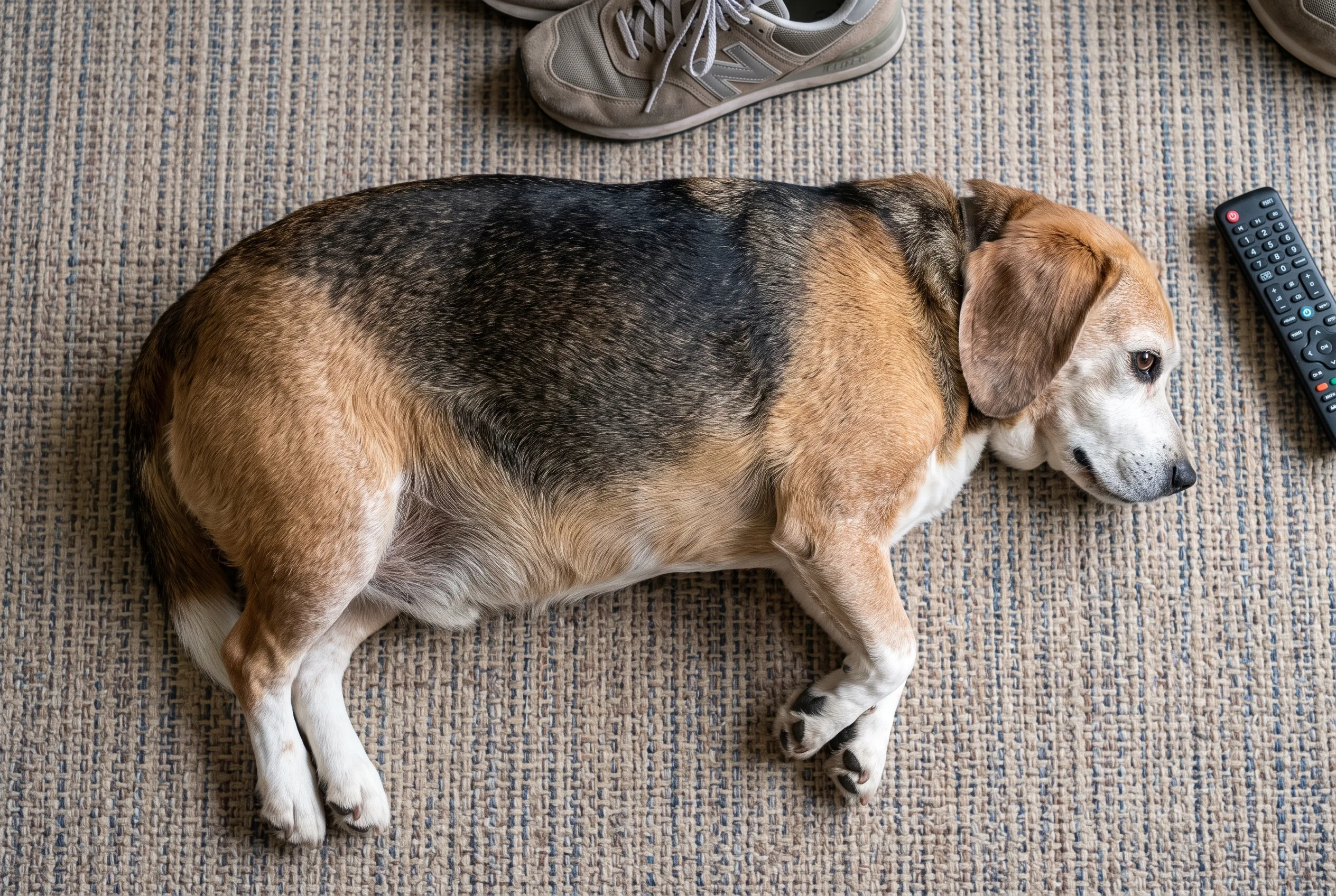
You Don’t Need a Scale. You Need to Look Twice.
Most owners of chunky dogs don’t see it. Not because they aren’t paying attention, but because they see the dog every day, and every day he looks the same as yesterday.
So do this tonight.
Look from above. Stand over him while he’s standing. Is there a waist behind the ribs, or does his body run straight from shoulders to hips like a loaf of bread?
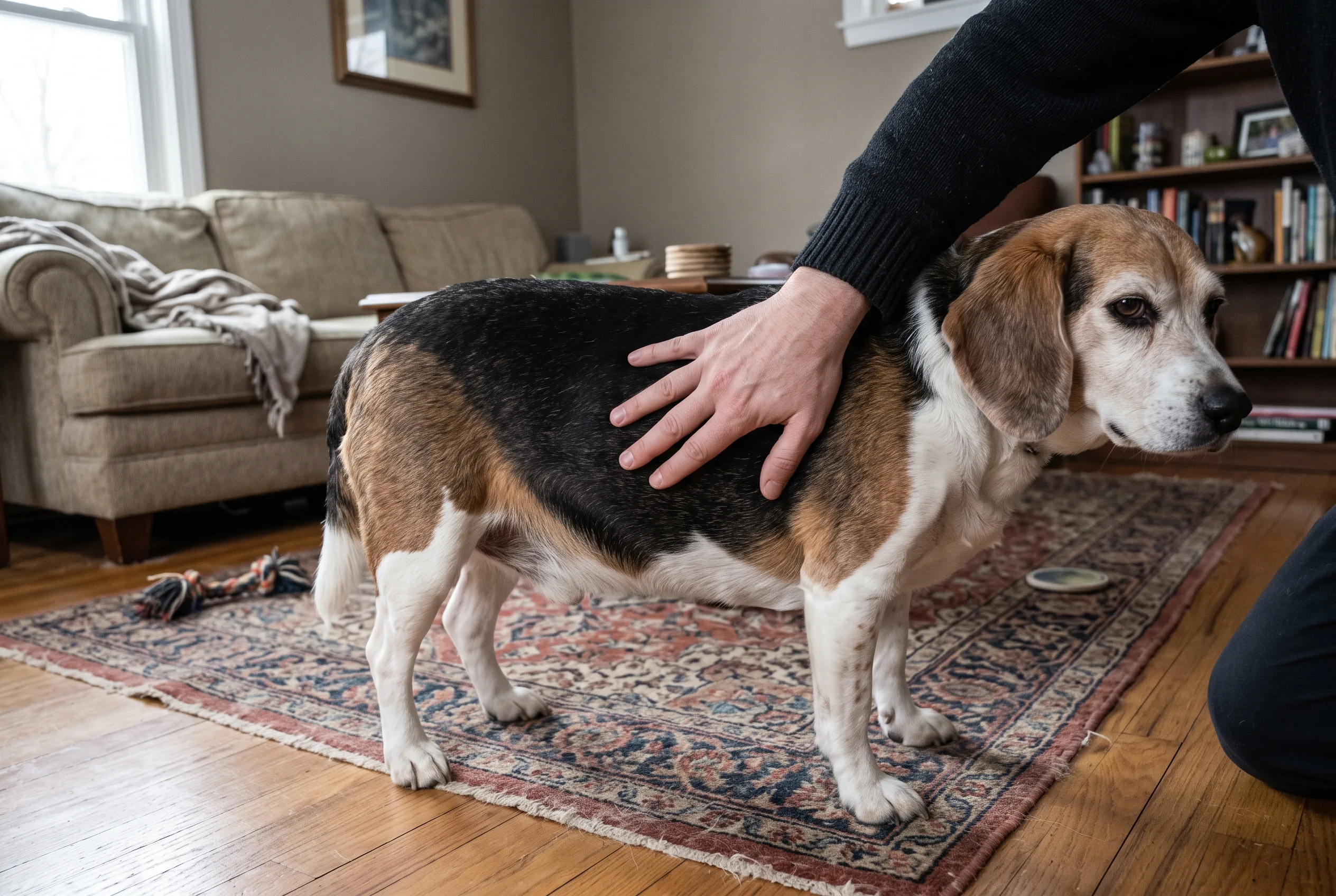
Feel the ribs. Run flat fingers along his side with light pressure. Can you find the ribs easily, or do you have to press?
Look from the side. Does the belly tuck up behind the rib cage, or does it hang level?
If two of those three made you pause, the third answer deserves a closer look. If all three looked fine, good. Age it is, and you can stop reading here with a clear conscience.
Almost Two More Years
Here is the part of this conversation that I take most seriously, and that most owners of older dogs never hear.
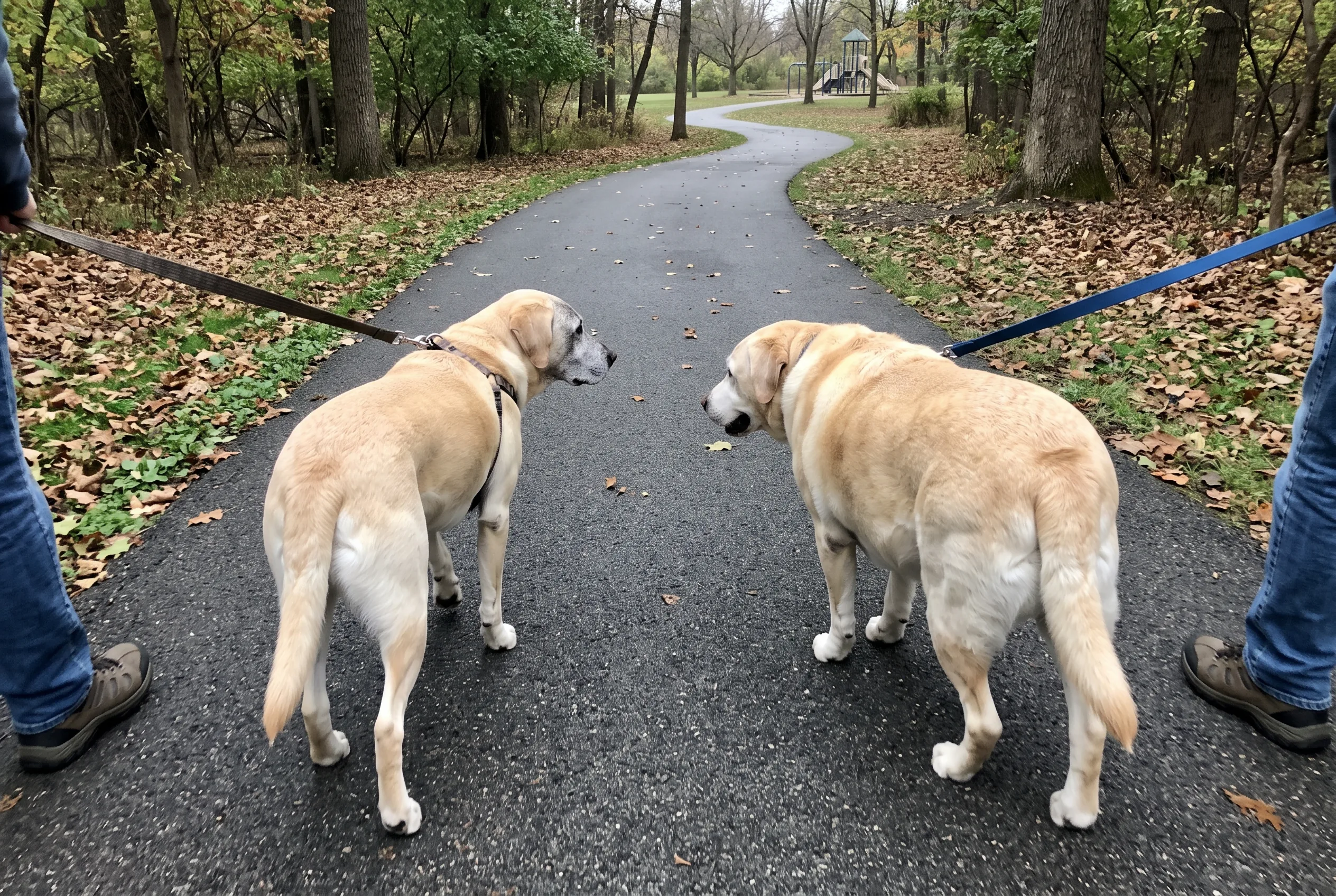
In the longest feeding study ever done on dogs, researchers followed 48 Labrador Retrievers for their whole lives. They were littermates, raised the same way. Half were fed a normal amount. The other half were fed a quarter less.
The leaner dogs lived a median of 1.8 years longer. Almost two more years.
That was a study, not a promise. It was not a study of any product, and it doesn’t mean you should cut your own dog’s food by a quarter tomorrow. A separate study from the University of Liverpool put the gap at up to two and a half years for heavier dogs across several breeds.
What it tells us is simple. For an older dog, the few extra pounds are not background. They are time.
“Why can’t they just live forever,” an owner wrote in a forum I read. They can’t. But the leaner ones, in the study, got a little closer.
“He’s Old. Isn’t a Diet Cruel?”
I hear this every week, and I understand it.
“I just don’t know if one cup twice a day would just be cruel,” a Lab owner wrote. He’s old. He’s earned his treats. Why take something away now?
Another owner answered him, and I couldn’t have said it better: “Not as cruel as killing him slowly with more food than he needs.”
But here’s the thing. You don’t have to take dinner away. You have to change what’s in it.
You don’t have to take dinner away. You have to change what’s in it.
Think of soup. A big bowl of broth-based soup fills you up on fewer calories than a small plate of crackers. Water and fiber take up space. In the bowl and in the stomach.
Do that in his bowl and the fight is over. Less kibble, more in the bowl. He eats a full dinner. You fed him less. Nobody has to be the bad guy at 6 pm, and nobody has to starve an old dog.
Owners have been doing a rough version of this for years with green beans and canned pumpkin. It works. It’s also messy, unmeasured, and the dog picks around the beans.
Four Things, or It Won’t Last a Month
Before I tell you what I use, here’s how I judge any fix, store-bought or homemade.
- 1It adds volume without adding calories that matter. Water and fiber, not fat, not more kibble.
- 2It's measured per pound of dog. “A handful of beans” is not a plan. A scoop per 22 pounds is.
- 3The dog wants it. If he picks around it, it's not a diet, it's a standoff.
- 4It works with the food he already eats. Switching brands at ten years old starts a new fight. Adding a step to the dinner you already make is something you'll keep doing.
Green beans pass the first test and fail the other three. Light kibble passes the second and fails the third and fourth.
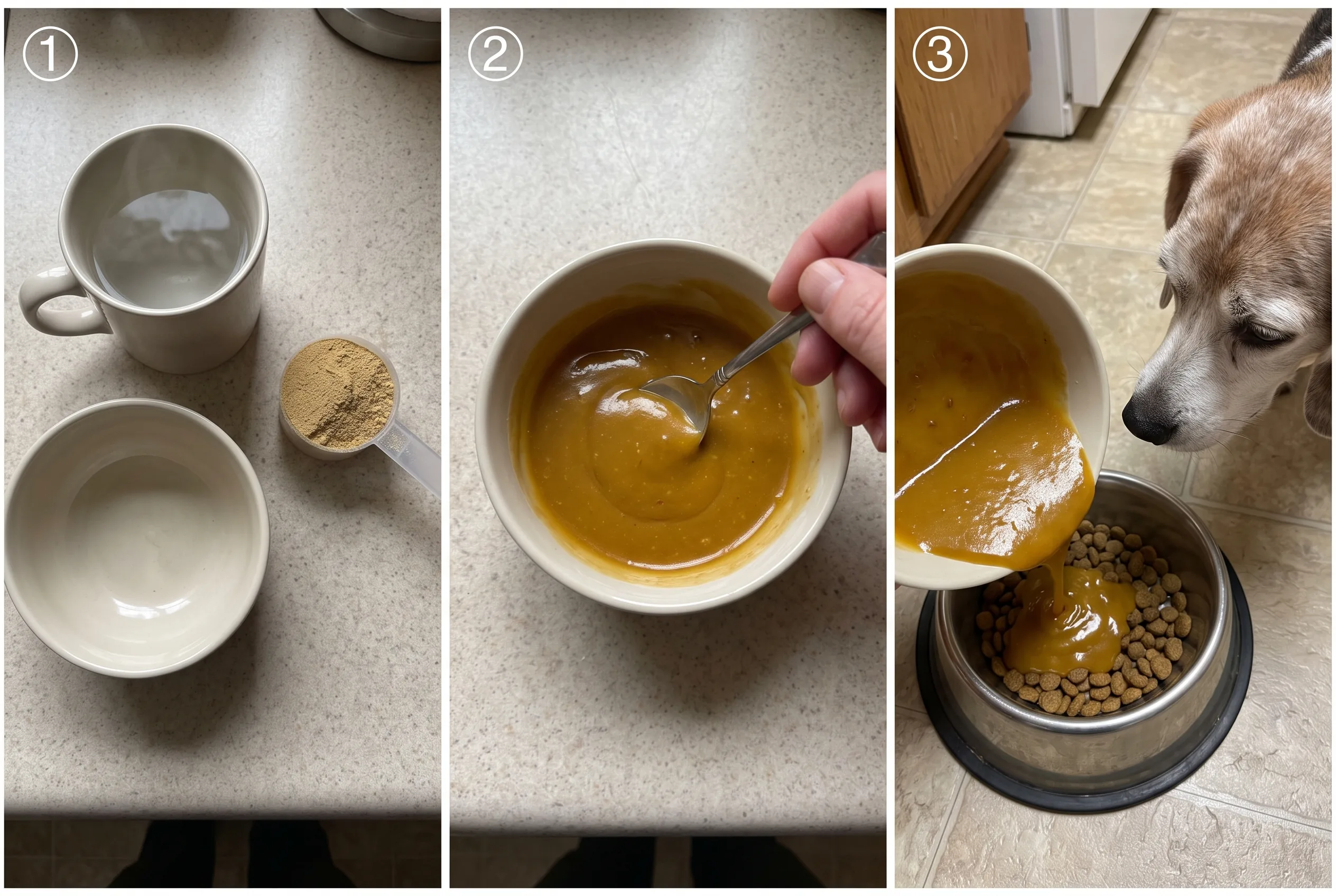
Less Kibble. A Full Bowl. Thirty Seconds.
BOWLFUL is a powder. You mix one scoop with warm water, wait a minute or two, and it turns into a thick chicken gravy. You pour that over a smaller portion of the kibble your dog already eats.
That’s the whole method.
Here is how it checks my four boxes:
- Volume without calories that matter. The gravy is mostly water and fiber. About half the powder is fiber, from gum arabic, pea fiber, psyllium husk and beet pulp. Chicken broth and chicken liver are in there for taste.
- Measured. One scoop per 22 pounds of dog per day, split over two meals. A 600 gram can lasts a 22 pound dog about two months, a 44 pound dog about a month.
- He’ll want it. It tastes like chicken gravy, because that’s mostly what it is.
- Works with his food. You don’t switch anything. You feed less of it and pour this over the top.
The honest part. BOWLFUL does not make a dog lose weight by itself. Feeding less kibble does that. BOWLFUL is what makes feeding less something you can actually keep doing, because the bowl still looks like dinner.
For an older dog, three adjustments. Take the kibble down in smaller steps than you would for a young dog. Weigh him once a month instead of every two weeks, and don’t chase a fast number. And if he takes any medication or has a health condition, talk to your vet before you change how you feed him.
What to Expect, Week by Week
- 1
Week 1
His usual portion plus the gravy. Nothing changes on the scale. This week is about getting him used to the new bowl. Most older dogs take to it at the first meal.
- 2
Week 2
Kibble comes down one small step. The bowl still looks full. This is the week the old diet used to break. It won't, because the bowl didn't shrink.
- 3
Weeks 3 to 4
Kibble down another step, up to 15 percent less than where you started. First weigh-in. A safe pace for a dog is 1 to 2 percent of his body weight a week, so a 60 pound dog loses about half a pound to a pound a week. Slow is correct, and for a senior, slower is better.
- 4
Weeks 5 to 8
The routine runs itself. Anyone in the house can do it, because the instructions are on the scoop.
If the scale hasn’t moved by week 4, the calories are coming from somewhere else. The dental chew. The plate licking. The grandkids. Look there first.
What Owners Tell Me
These are owners who gave me permission to share their numbers. I’m sharing them because they’re typical, not because they’re special.
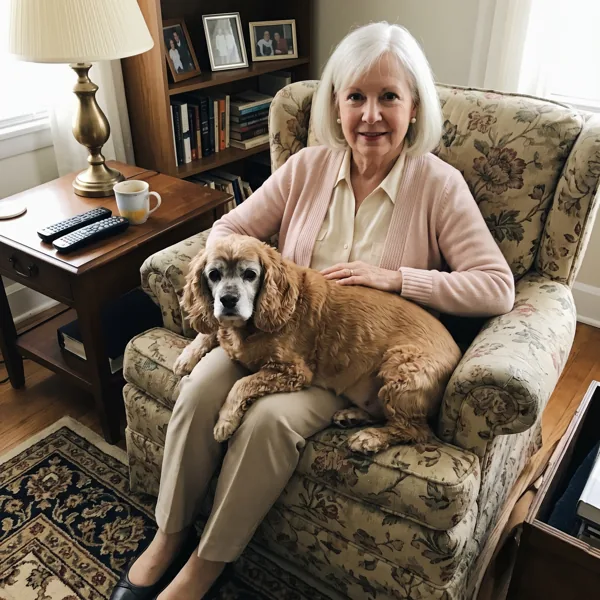
Carol and Molly
Cocker Spaniel mix, 11
34.6 lb to 32.9 lb in 9 weeks · walks to the leash on her own again and takes the stairs
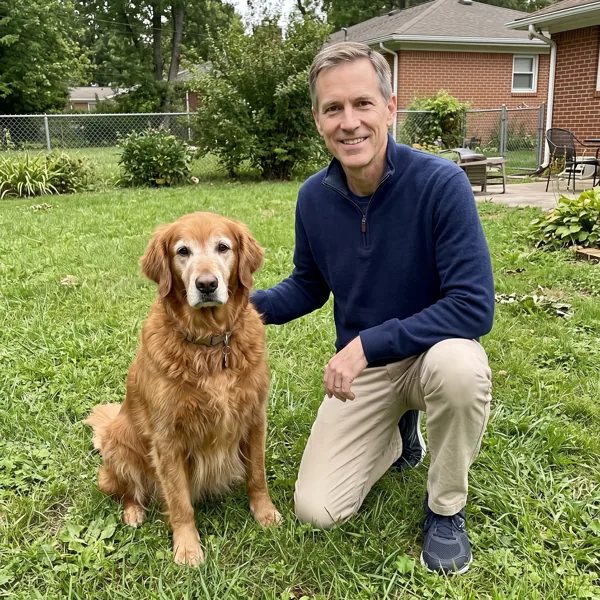
James and Bailey
Golden Retriever, 9
“I still give him the chew. I just realized that wasn’t the whole problem.”
91.3 lb to 88.6 lb in 7 weeks · still on his joint chew · gets up more easily
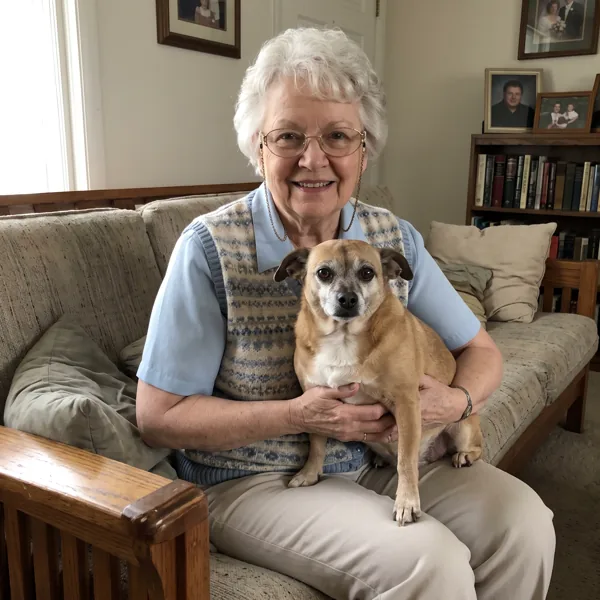
Patricia and Lucy
Chihuahua mix, 10
“She’s only 12 pounds, so I use half a scoop. One can lasts us close to two months.”
12 lb · half a scoop a day
Questions Before You Start
Isn't he too old to change his food?
You’re not changing his food. You’re feeding less of it and pouring gravy over it. The kibble stays the same.
Won't a topper add calories?
Peanut butter does. Cheese does. BOWLFUL is mostly water and fiber, and the calories are counted in the plan.
More fiber means more poop, right?
It can, if you go from nothing to a full scoop overnight. That’s why week 1 is gradual. Most owners see normal, firmer stools.
My old girl is picky.
The base is chicken broth and chicken liver. If she refuses chicken, this isn’t for her.
He takes medication.
Ask your vet before you change his feeding. Bring the plan with you.
How fast will I see something?
On the scale, about a month. At the stairs and the door, owners usually notice before the scale does.
Who This Is For, and Who It Isn’t
For:
- older dogs who have slowed down and failed two of the three checks
- dogs who act hungry on a smaller portion
- households where more than one person feeds the dog
Not for:
- puppies
- pregnant or nursing dogs
- underweight dogs
- dogs with a diagnosed condition that needs a prescription diet unless your vet says yes
- dogs allergic to chicken
The Short Version
Your dog is getting older. That part is real and you can’t change it.
But if the walks are shorter, the couch takes a run-up and the naps got longer, look at him from above before you blame his birthday. Feel for the ribs.
If the waist is gone, that part you can change. Less kibble, full bowl, weigh him in a month.
The owners who do it almost all say the same thing. “I have my dog back.”
Evidence Sources
- Kealy RD et al. Effects of diet restriction on life span and age-related changes in dogs. Journal of the American Veterinary Medical Association, 2002;220:1315-1320. 48 Labrador Retrievers, 25 percent restriction, median lifespan 13.0 versus 11.2 years. PubMed
- Lawler DF et al. Diet restriction and ageing in the dog: major observations over two decades. British Journal of Nutrition, 2008. PubMed
- Salt C et al., University of Liverpool and Royal Canin, 2019. Association between life span and body condition in neutered client-owned dogs. Journal of Veterinary Internal Medicine. University of Liverpool
- Association for Pet Obesity Prevention, 2022 U.S. prevalence survey and 2024 owner survey. APOP
- Cornell Riney Canine Health Center, safe weight-loss rate of 1 to 2 percent of body weight per week. Cornell
These sources support the general discussion of age, body weight and lifespan in dogs. They are not studies of BOWLFUL.